










GPUs Pro Reviews Studio Workstations

A real surprise – Intel Arc Pro B50 in the test and big workstation duel under 450 euros

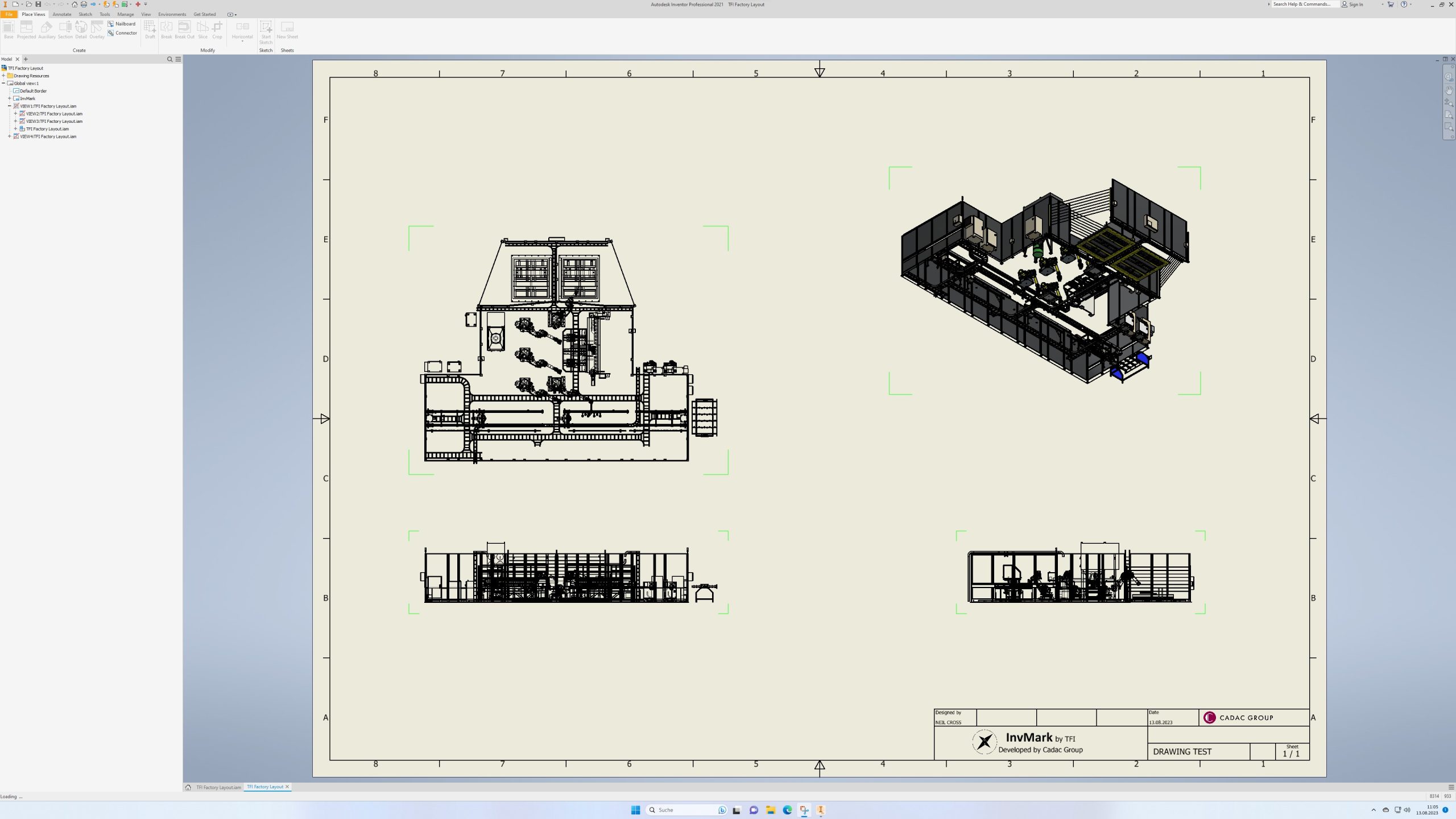
Autodesk Inventor Pro is a standard tool in mechanical design that combines parametric modeling, large assemblies and simulation-based workflows in one environment. This is precisely why Inventor is very well suited for evaluating workstation graphics cards in a practical manner. The InvMark add-on maps typical Inventor subtasks and condenses the results into scores using the geometric mean, which reflect the real interaction speed in the viewport and during drawing-related operations. It is important to separate the GPU-relevant sub-areas from purely processor-related tests.
Some single-threaded and multi-threaded benchmarks, such as ray tracing, are primarily CPU load and they hardly influence the choice of graphics card. I have therefore deliberately left them out of the chart package. They were nevertheless measured, but the differences are small, as expected. They are of course included in the overall score.
 

Total score

The NVIDIA RTX A1000 is ahead in the overall score with 62018 points, closely followed by the Intel Arc Pro B50 with 60620 points. The AMD Radeon Pro W7500 follows with 58698 points. The RTX A1000 thus narrowly wins the InvMark, its lead over the Arc Pro B50 is only around 2.3 percent, while the B50 is around 3.3 percent ahead of the W7500. In practice, this means that all three cards run Inventor smoothly, but the ranking is in favor of the A1000 in mixed workflows.

Graphics

In the graphics sub-ranking, the RTX A1000 came out on top with 1618 points, the Arc Pro B50 achieved 1545 points and the Radeon Pro W7500 1378 points. This puts NVIDIA around 4.7 percent ahead of Intel, while Intel is around 12 percent ahead of AMD. In heavily viewport-heavy 3D scenes, such as when rotating and shading larger assemblies, the lead is noticeable.


Drawing

The differences in drawing operations are very small. The RTX A1000 achieves 1722 points, the Arc Pro B50 1710 points and the W7500 1657 points. NVIDIA is only around 0.7 percent ahead of Intel here, while both are separated from AMD by around 3 to 4 percent. For classic 2D derivations and dimensioned drawings, all three cards are almost on a par, with slight advantages for the A1000 and B50.

Dynamic SIM

In the dynamic simulation, the RTX A1000 shows the largest gap with 2484 points, the Arc Pro B50 achieves 2095 points and the W7500 2013 points. This puts NVIDIA around 18.6 percent ahead of Intel and around 23.4 percent ahead of AMD. Those who frequently work with simulation views in Inventor and visualize interactive processes will benefit the most here.

Assembly constraint

The picture is slightly different for assembly constraints. With 1800 points, the Arc Pro B50 is just ahead of the RTX A1000 with 1778 points, followed by the W7500 with 1731 points. The B50 has a lead of around 1.2 percent over NVIDIA and just under 4 percent over AMD. In assemblies with many dependencies, this results in slightly more direct handling.

Assembly pattern

The RTX A1000 is once again in the lead in the assembly pattern with 1886 points, just ahead of the Arc Pro B50 with 1865 points. The W7500 is well behind with 1572 points. The gap between the A1000 and B50 is just over 1 percent, but both are almost 20 percent ahead of AMD. Repeated feature patterns and large patterns thus benefit from the two top-ranked cards.

Conclusion

Inventor Pro 2021 shows a clear but overall narrow hierarchy. The RTX A1000 delivers the highest overall score and is particularly strong in Graphics, Dynamic SIM and Assembly Pattern. The Arc Pro B50 follows very closely, impressing with the best result in Assembly Constraint and stable values in all other sub-areas. The Radeon Pro W7500 remains competitive, but falls visibly behind in graphics and simulation-heavy tasks, but keeps up well in Drawing. Those who use Inventor widely are best served with the RTX A1000 at the upper end, but the Arc Pro B50 is the balanced alternative with selective strengths in complex assemblies, while the Radeon Pro W7500 is more recommended for more drawing-heavy workflows.


Kommentar

Lade neue Kommentare

Y
Yumiko

Urgestein

1,282 Kommentare 587 Likes

Hm, bei den KI Benchmarks besser ROCm nutzen. Nutze ich unter Windows auch bei RDNA3 (primär über LM Studio für Text/Voice, aber auch Amuse für Bild/Video).
Nur die kleine 780M im Tablet wird nicht unterstützt, da gehen nur die Fallbacks.

Antwort 1 Like

O
Oberst

Veteran

391 Kommentare 179 Likes

Oder ZLuda, in SD war das bei mir noch mal merklich schneller als ROCm. Ist für den produktiven Einsatz aber eher nicht passend, da nicht offiziell.

Da würde ich mir aber sorgen machen, wenn das Kupfer nicht angelötet ist. Wenn mal die Werkzeuge etwas älter sind und mehr Toleranzen verursachen, wer garantiert dann noch, dass der CU-Block großflächig Kontakt zum Aluminium hat?
Klar, man kann das Werkzeug entsprechend früh wechseln, aber ob das dann immer so eingehalten wird, da habe ich so meine Zweifel.

Antwort 1 Like

Igor Wallossek

1

13,159 Kommentare 26,153 Likes

Ich nicht, denn es zählt, wo die Kühlung aufsitzt und die funktioniert bestens. Nichtkorrosives Löten ist in der Fläche eher meh. :)

Antwort 1 Like

P
Pokerclock

Urgestein

978 Kommentare 959 Likes

Testsamples wurde von Intel gestellt? Habe jetzt nichts dazu gelesen bzw. es wohl schlicht überlesen. Gab es wenn ja gleich die RTX A1000 dazu?

Es fällt auf, dass überall der alte Nvidia-Schinken in Form der RTX A1000 gegenübergestellt wird. Preislich mag das eine Kategorie sein, aber technisch (und auch aus Kundensicht) wäre die A2000 Ada die Karte der Wahl. Mit so einer 8 GB Workstation-Karte holt man ja in der KI-Welt überhaupt nichts mehr raus. Daher hätte ich die A2000 Ada doch gerne gesehen.

Mal ganz davon abgesehen, dass das Namensschema von Nvidia absoluter Müll ist...

Antwort Gefällt mir

Igor Wallossek

1

13,159 Kommentare 26,153 Likes

Und warum hat keiner die W7500 mit drin? Unter uns: die A2000 mit 6GB ist eine Lachnummer... Ich finde es nach Preis fairer

Vergleiche mal W7500 und A2000 und dann die W7500 mit der B50. Die A2000 und die A1000 nehmen sich nicht viel :)

View image at the forums

View image at the forums

Meine 12GB Version ist defekt und die 6GB lief nicht in UHD.

Antwort Gefällt mir

P
Pokerclock

Urgestein

978 Kommentare 959 Likes

A2000 Ada, nicht A2000 ohne Ada. Da haben wir wieder das blöde Namensschema...

Kostet schlanke 500 € netto...

Also von Intel gesponsert, denke ich mal? Hoffentlich nur die eigene Karte. 😅

Antwort Gefällt mir

Igor Wallossek

1

13,159 Kommentare 26,153 Likes

Das ist nicht mal die Hälfte... 😉
Die meisten Pascal, Turing und Ampere liegen im Lager.

View image at the forums

Antwort 4 Likes

Igor Wallossek

1

13,159 Kommentare 26,153 Likes

Die B50 ist von Intel, richtig. Sonst hätte man ja nichts zum Testen gehabt.

Antwort 2 Likes

P
Pokerclock

Urgestein

978 Kommentare 959 Likes

View image at the forums

Immer diese übervollen Regale...

Ich wundere mich halt, dass dieses Mal kein Hinweis am Ende des Artikels war der auf die Testsamples, Testbedingungen etc. hinweist.

Daher frage ich mal ganz offensiv. Die A1000 kam auch von Intel? Diese A1000 Inflation überall ist auffällig.

Antwort Gefällt mir

Igor Wallossek

1

13,159 Kommentare 26,153 Likes

Ich habe sie alle 😆 Aber es wurde angeboten.

Vergessen. Eigentlich bin ich krankgeschrieben. NVIDIA von NVIDIA über PNY, AMD von AMD und Intel von Intel.

Antwort 5 Likes

P
Pokerclock

Urgestein

978 Kommentare 959 Likes

Ich nehme das dann mal als ein "war nicht notwendig". :ROFLMAO:

Antwort 1 Like

Igor Wallossek

1

13,159 Kommentare 26,153 Likes

Ich fand es eher lustig, dass Intel keine AMD angeboten hat

Antwort 3 Likes

P
Pokerclock

Urgestein

978 Kommentare 959 Likes

Danke dir für die Info und die Offenheit.

Ich hatte es schon vermutet, dass die Testauswahl zum Teil bezuschusst wurde bei anderen Testern.

Nutzt leider niemanden. Die olle A1000 verkauft keiner, der seinen Kunden auch wirklich helfen möchte. Zumindest ist das mein Anspruch gegenüber meinen Kunden. Sieht nur gut aus für Intel in den Benchmarks. Und wenn man dahinter guckt, hat Intel selbst seine Finger im Spiel bei der Auswahl und man kann trotz der vielen Arbeit nur bedingt was für sich herausziehen an Erkenntnis.

Antwort Gefällt mir

Igor Wallossek

1

13,159 Kommentare 26,153 Likes

Die A2000 Ada ist aber auch nicht wirklich schneller. 🤦 Das ist eine 6GB Karte und die 12GB im Clamshell scheitern meist am dünnen Interface

Antwort Gefällt mir

P
Pokerclock

Urgestein

978 Kommentare 959 Likes

Die A2000 Ada hat 16 GB und gibt es auch nur so. Du meinst die A2000 OHNE Ada aka eine Generation älter.

Antwort Gefällt mir

e
eastcoast_pete

Urgestein

3,083 Kommentare 2,046 Likes

Egal ob man jetzt Intel aus Prinzip nicht mag oder nicht, gerade bei halbhohen low-power dGPUs in Einsteigerbereich für produktiven Einsatz gibt's sonst wenig Auswahl, v.a. wenn man > 8 GB VRAM braucht. Frischer Wind ist hier IMHO sehr willkommen. Mit der Ausnahme bei Solidworks (soll ja laut @Igor Wallossek noch was kommen) scheint sich das Treiber Team um Tom Peterson hier wirklich reingekniet zu haben.

Und das macht mir Hoffnung, daß Intel vielleicht doch bei dGPUs weitermachen will. Mit Ausnahme der 9060/9070 AMD Karten für Gamer ist's bei dGPUs doch fast eine grüne Monokultur (Siehe die Verkaufszahlen!) Es ist doch auch bezeichnend, daß Nvidia nach wie vor Kunden für ihre Ampere A1000 findet. Wer hier Ada und mehr als 8GB VRAM will, muß ablöhnen, und nicht zu knapp!
Da Jensen Huang es sehr persönlich nimmt, wenn jemand Nvidia irgendwo Marktanteile streitig macht, könnte die B50 auch der Tritt in den grünen Hintern sein, der Nvidia zu einer kleinen low-power Profi Karte mit 16 GB VRAM auf Blackwell Basis motiviert.

Jetzt bin ich auch gespannt, wo die B50 vom Preis her landet. Unter bzw um ~ € 400 wär wirklich interessant!

Antwort 1 Like

Klicke zum Ausklappem
e
eastcoast_pete

Urgestein

3,083 Kommentare 2,046 Likes

Wieviel kostet eine A2000 Ada (16GB) denn im Moment? Der Preis spielt doch auch eine Rolle, je nach Kunde und Einsatz.
@Igor Wallossek Frage, um auf @Pokerclocks Einwand einzugehen: Hatte Intel hier bestimmt, welche Nvidia und AMD Karten mit im Vergleich getestet wurden?
Kann ich mir zwar nicht vorstellen, aber eine Klarstellung wär wichtig.

Antwort Gefällt mir

konkretor

Veteran

448 Kommentare 494 Likes

Denke die wo im Test sind, sind schon die Konkurrenz von Intel. Ähnliches Preissegment und Leistung.
Da hat Intel wirklich geliefert. Die Treiber Abteilung, haut ja gefühlt auch alle 2 Wochen was raus. So schlimm sind die Treiber nicht mehr wie am Anfang. Wären sie gleich so gewesen, wäre die Akzeptanz viel besser gewesen. Jetzt ist es nun mal wie es ist

Antwort 1 Like

Igor Wallossek

1

13,159 Kommentare 26,153 Likes

Nein. Die A1000 war ein sinnvoller Vorschlag, aber kein Dogma und die AMD ist auf meinem Mist gewachsen. Ich hätt auch eine RTX 5090 nehmen können 😂

Antwort 2 Likes

Danke für die Spende


Du fandest, der Beitrag war interessant und möchtest uns unterstützen? Klasse!

Hier erfährst Du, wie: Hier spenden.

Hier kannst Du per PayPal spenden.

About the author

Igor Wallossek

Editor-in-chief and name-giver of igor'sLAB as the content successor of Tom's Hardware Germany, whose license was returned in June 2019 in order to better meet the qualitative demands of web content and challenges of new media such as YouTube with its own channel.

Computer nerd since 1983, audio freak since 1979 and pretty much open to anything with a plug or battery for over 50 years.

Follow Igor:
YouTube Facebook Instagram Twitter

Werbung

Werbung