










Category - Basics

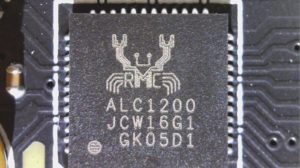
Realtek ALC1200 demystified – what really distinguishes the entry-level sound chip from the larger ALC1220

Today I would like to update you on a detail that is often overlooked in practice, although it is crucial for the correct classification of measured values and manufacturer specifications. This is the distinction between front header and front audio. While the front header refers to the internal pin connector on the mainboard, via which the cable [...]


Blackscreens and data loss on graphics cards: When the PCI SIG is caught in the tolerance trap and PCIe Gen5 is already failing at the edge of the card | Investigative

Today’s article grew out of a series of concrete observations in everyday testing that prompted me to take a closer look at the PCIe slot and the add in card edge connector mating interface. In my test systems I generally use PCIe 5.0 riser cards to avoid repeated plugging and unplugging at the motherboard, since the slot does not get better with [...]


Clock Work Tea Party CWTP EG4GUV-L thermal paste in the world’s first real test: a flavored paste that smells of osmanthus and stinks to death

Sometimes failure just smells damn good. For example, when a thermal paste comes across like a bottle of niche fragrance from Kyoto – floral, sweet and with a hint of “What the hell is that?”. CWTP EG4GUV-L, as its somewhat unwieldy name suggests, exudes a hint of osmanthus, a flower that is used in Asia for tea, perfume and [...]


Can you stack thermal pads to achieve thicker layers? Thermal Grizzly Minus Pad Pro Review and an astonishing finding | Practice

I am often asked whether it is permissible or even sensible to stack thermal pads if the exact thickness is not available and you don’t want to use thermal putty. This is exactly what I would like to answer today, because this issue is far less critical than it is often made out to be. In fact, the targeted stacking of pads can even be a [...]


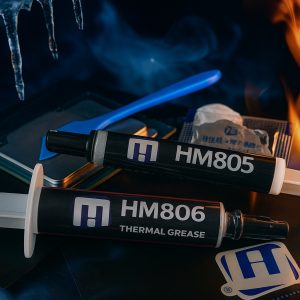
Huamei HM 806 and HM 805 Thermal Paste Review – A new sub-brand from a well-known manufacturer and two new pastes

Huamei is a new sub-brand of the Chinese coolant manufacturer Halznziye, which has been operating more in the background to date and has been set up specifically for the international market. While at first glance the name sounds like a typo by Huawei, Huamei is not a technology company with smartphone ambitions, but a specialized product line for [...]


AMD Ryzen 9000 X3D RAM Reference Guide – 8200 2:1 vs. 6400 1:1, 2R vs. 1R, Optimized vs. EXPO vs. JEDEC in Synthetics and Gaming

Ryzen X3D CPUs are known to be a force in gaming, even without fast RAM. However, this doesn’t mean that optimized system memory settings can’t be used to achieve even better performance. After all, the cache is just that – a cache – and sooner or later the data has to be written to or read from the RAM. Not every gamer has the time [...]


Why half as thick is not automatically twice as good: Limits of layer thickness reduction in thermal pastes and a change in the thermal paste charts

Anyone who has been keeping a close eye on my thermal compound database since today will certainly not have overlooked a small addition. In my comparative characterization of thermal interface materials (TIM), a uniform lower limit of the bond line thickness (BLT) of 25 µm was deliberately chosen (purely graphically). This decision is based on [...]


Shin Etsu MicroSi X-23-7921-5, X-23-7783D and G7762 Thermal Paste Review – Large particles for large numbers and large problems

Today I’m testing the Shin Etsu MicroSi X-23-7921-5 , the MicroSi X-23-7783D and the MicroSi G7762. Once again, my thanks go to the community for the kind procurement. All three pastes are actually not that bad, but they show the typical problem when the manufacturer tries to generate great values. That’s why I’m using the whole [...]


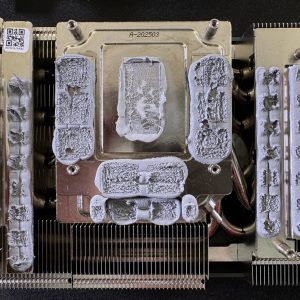
Faulty chip surface ex works on a Radeon RX 9070XT, extreme hotspot temperatures and research into the causes of pitting (Update #2)

As part of a reader request, I was given a new PowerColor Radeon RX 9070XT Hellhound for analysis, in which unusually high GPU and hotspot temperatures were observed under load, which suggests an uneven or locally disturbed thermal coupling of the GPU die. Despite proper reapplication of a high-quality PTM pad and additional thermal putty instead [...]