
















Rendering with Blender 3.6
Blender is a comprehensive open source software for 3D graphics, animation, rendering, post-production and interactive applications. It offers everything you need to create, edit and render complex 3D scenes. In addition to the classic 3D functions, Blender also includes tools for video editing, sculpting, UV mapping, texturing, rigging, particle simulations, physics and fluid simulations as well as basic game engine functionalities. Thanks to this enormous range of functions and its free availability, Blender is used by beginners, ambitious artists and professional studios alike throughout the media and design industry.
Before the benchmark results can be properly classified, it is worth taking a brief look at the underlying computing frameworks CUDA, OptiX, HIP and OneAPI. These technologies were developed for highly parallel calculations (High Performance Computing, HPC) and form the basis for GPU acceleration in the Cycles renderer. Blender 3.6 LTS uses different compute backends depending on the hardware used in order to optimally distribute the computing load between the CPU and GPU. Which backend is used depends on the graphics card and the installed drivers – and this has a significant impact on performance in the benchmark.
NVIDIA relies on CUDA as a proven basis and OptiX as a ray tracing extension. AMD uses HIP as the modern successor to OpenCL, while Intel offers complete GPU support in Blender for the first time with OneAPI. The respective degree of optimization of these interfaces is decisive for how efficiently the hardware works in the Cycles renderer. This is why NVIDIA usually achieves the highest frame rates in GPU rendering, AMD is in the solid midfield, and Intel is currently still heavily dependent on software updates to fully exploit the available potential.
CUDA is NVIDIA’s proprietary interface for GPGPU computing and has been the standard for general GPU calculations in Blender for many years. It is supported on almost all NVIDIA cards from the Kepler generation onwards and delivers stable, reproducible results. In Cycles, CUDA serves as a proven basis, especially when OptiX cannot be used or older GPUs are in use. OptiX, on the other hand, is NVIDIA’s specialized ray tracing API that accesses RTX GPUs and enables significantly accelerated path tracing thanks to its RT cores. OptiX offers massive performance advantages over CUDA, especially in scenes with a lot of light and shadow calculations.
AMD’s HIP (Heterogeneous Compute Interface for Portability) replaces the outdated OpenCL and forms the current backend for Radeon GPUs from the RDNA2 generation onwards. Although the implementation is not quite as mature as NVIDIA’s solutions, it shows noticeable progress with every Blender version. In the benchmark, this means that Radeon cards offer solid raw performance in HIP mode, but often lag somewhat behind the CUDA and OptiX results in practice.
Intel uses OneAPI, an open, cross-platform architecture for heterogeneous computing. In Blender, it serves as the primary backend for GPUs from the Arc series and allows the Xe cores to be used for path tracing tasks. Performance is currently still heavily dependent on driver maturity and integration in Blender, but improves with each version. For the Arc Pro B50 and B60, OneAPI is crucial to enable GPU-accelerated rendering at all – and at the same time ensures that Intel’s cards become increasingly competitive in Blender benchmarks.
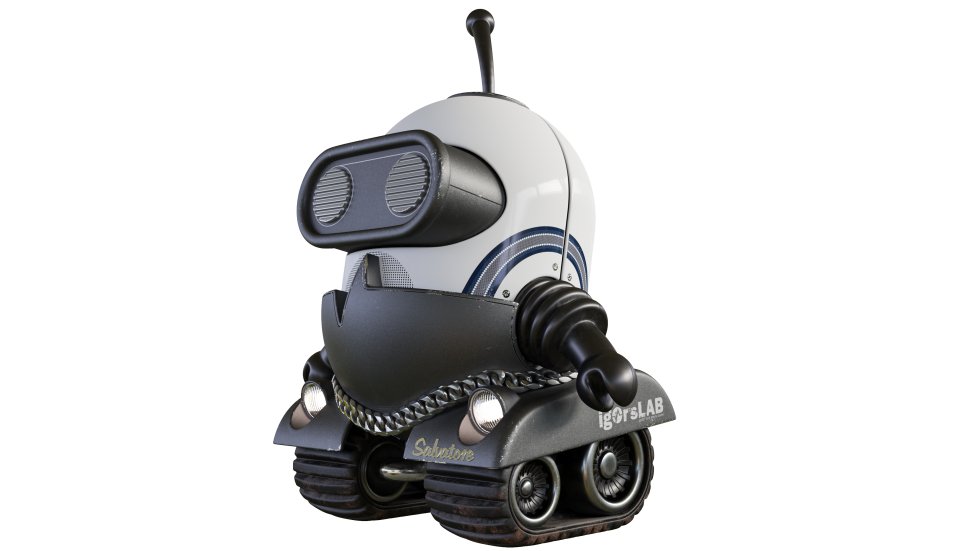
Blender rendering based on the igoBOT workload
The results of the igoBOT workload make it very clear how differently the available render paths work and how strongly the respective architectural advantages have an effect. NVIDIA continues to achieve the shortest render times thanks to OptiX, because the backend consistently uses the available RT cores and thus achieves an almost linear acceleration, especially in scenes with complex geometry and extensive material interactions. The RTX 4000 Ada is the clear leader, followed by the RTX 2000 Ada, which scales very efficiently despite its reduced hardware configuration.

The performance picture for AMD is much more differentiated. The Radeon AI R9700 is the fastest AMD card tested within the HIP backend and is clearly positioned in the upper performance segment. It undercuts the rendering time of its direct gaming sister RX 9070XT and shows that AMD’s optimizations for workstation driver paths and the technical adaptation to professional workflows have a measurable impact. Despite this good position, however, the gap to OptiX remains, as HIP does not use specialized ray tracing acceleration in this scenario. The Radeon Pro W7800 falls slightly behind, which can be explained by more conservative driver paths and the focus on maximum stability. The older or smaller Pro models are ranked in the lower third according to their technical features.
Intel benefits in this test from the tight structure of the OneAPI backend, which works surprisingly efficiently with Arc hardware. Both Arc-Pro models deliver comprehensible, stable results, but without reaching the performance ranges of OptiX or the more powerful HIP implementations. As expected, the purely CUDA-bound A1000 ends up at the end of the field, as it has to make do without any form of RT acceleration and is architecturally intended for completely different areas of application.
Interim conclusion
The performance of the igoBOT rendering shows a clear hierarchy that can be explained in a technically coherent manner. NVIDIA remains the leader thanks to OptiX and the close integration between the software stack and dedicated ray tracing units. The AMD Radeon AI R9700 performs remarkably well in this environment. Not only is it the fastest HIP-based solution in the test, but it also delivers consistent and reproducible behavior that underscores its focus on professional workflows. The gap to OptiX can be explained by the lack of hardware acceleration in the HIP path, without this diminishing the internal consistency of the results. The Radeon Pro models follow according to their driver-side priorities, which are optimized for stability and deterministic execution rather than peak performance. Intel shows a clean, but hardware-limited OneAPI performance.
Overall, this test confirms that the Radeon AI R9700 clearly occupies the role of the fastest and most homogeneous render accelerator within the AMD portfolio. It does not achieve the absolute dominance of OptiX, but offers robust, predictable rendering performance that is perfectly adequate for many productive Blender workflows.

- 1 - Introduction and technical data
- 2 - Test system and equipment
- 3 - Autodesk AutoCAD
- 4 - Autodesk Inventor Pro
- 5 - PTC Creo
- 6 - Dassault Systèmes Solidworks
- 7 - Autodesk Maya
- 8 - SPECviewperf 15 (2025)
- 9 - Adobe Photoshop 26.10
- 10 - Adobe After Effects 2025
- 11 - Adobe Premiere Pro 25.41
- 12 - KI Benchmarks (AI Vision, Image, Text)
- 13 - Rendering
- 14 - Temperatures, clock rate, fans, noise and power draw
- 15 - Summary and conclusion













19 Antworten
Kommentar
Lade neue Kommentare
Urgestein
Mitglied
Urgestein
1
Urgestein
Mitglied
1
Mitglied
Mitglied
Urgestein
1
Urgestein
1
Urgestein
Veteran
1
Veteran
Veteran
Urgestein
Alle Kommentare lesen unter igor´sLAB Community →