















Do you remember my OBS server build? That was the project where I finally had a practical excuse not only to test an absurdly large hard disk, but also to use it productively. The WD Red Pro with its 26 terabyte capacity has been playing a major role there for some time now, now also privately. If you haven’t read the article on the server yet, you should do so, because the setup provides the right context for everything I’m going to show you today.
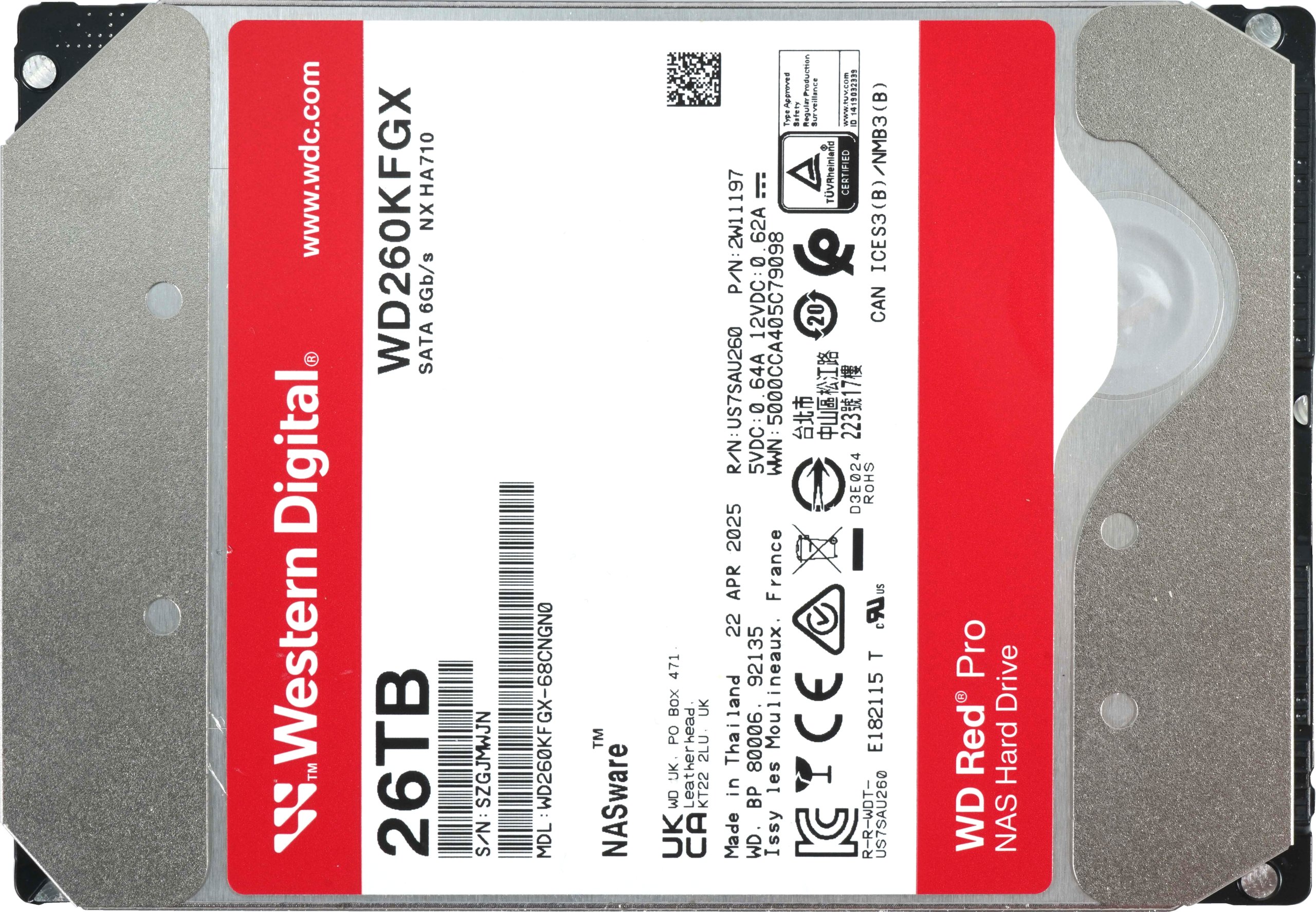
This review is about exactly this hard disk. The WD Red Pro 26TB has to prove itself today under real conditions and doesn’t get any special treatment. It should not be forgotten that this drive, with a street price of over 600 euros, is still in price regions where you almost expect the sectors to defragment themselves in the morning and the file system to politely announce itself before it writes. Today I’m going to take a look at all the relevant features of the disk and show how the model performs in continuous use, under load and in typical server tasks. So if you want to know whether this investment is worthwhile or whether the money would have been better spent on two smaller disks, you can now get the full load of data, tests and technical classification.
Brief introduction and classification of the WD Red Pro 26 TB
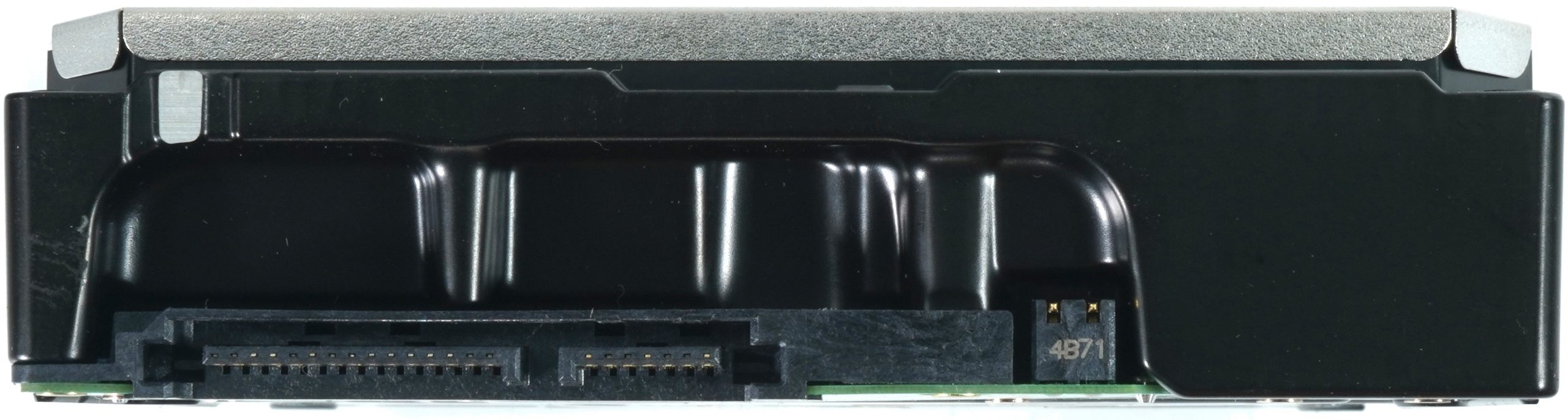
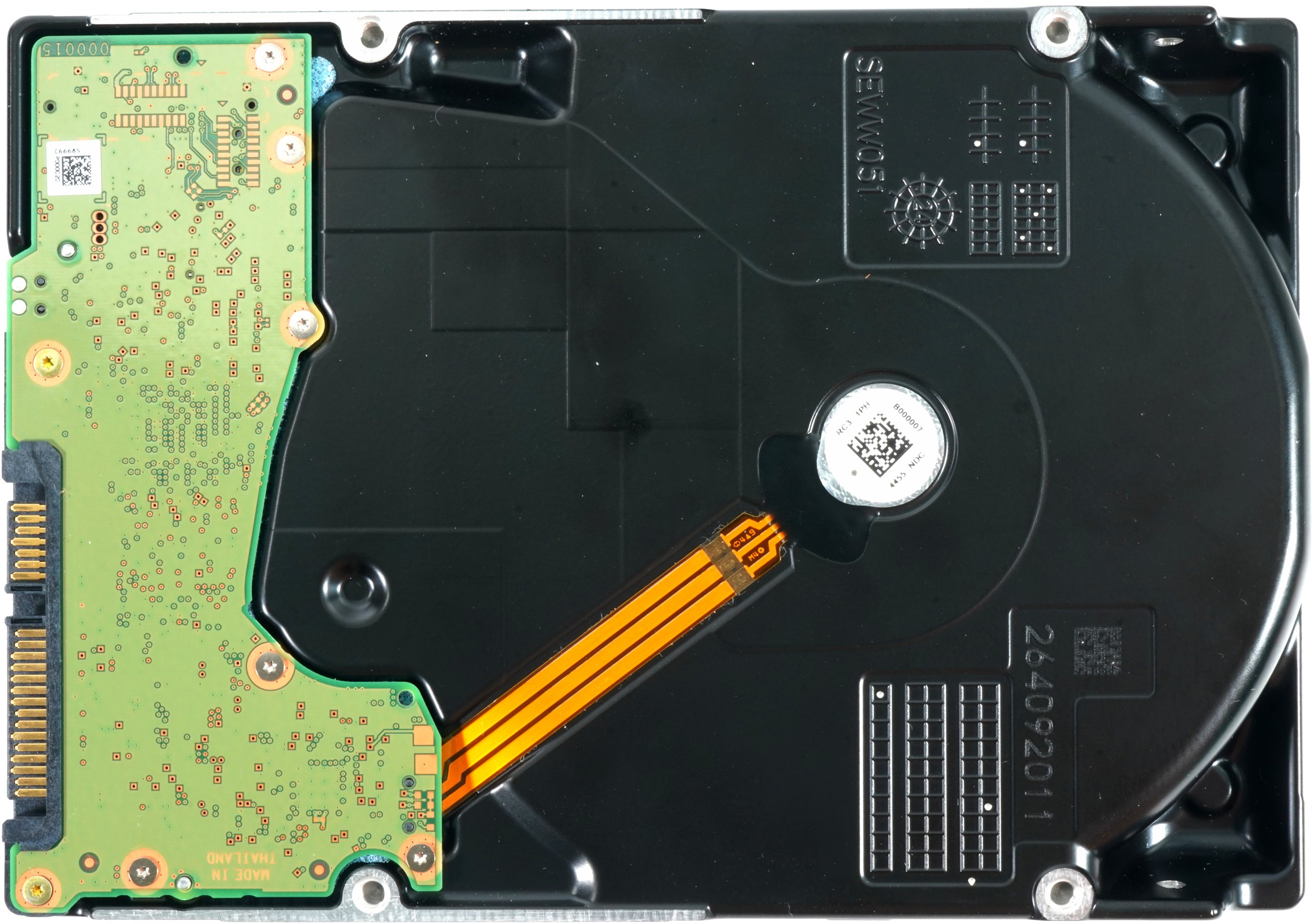
The WD Red Pro 26TB currently marks the top end of what Western Digital offers in the SATA CMR segment for NAS applications. The drive is based on a helium design with ten platters of 2.6 terabytes each, classic CMR technology and a constant speed of 7200 revolutions per minute. A 512 MiB DRAM cache buffers accesses, the transfer rates are up to 265 MB/s according to the data sheet. In technical terms, this is a tried-and-tested setup that aims for high long-term reliability in 24/7 continuous operation. As part of the Red Pro series, the drive is approved for NAS systems with up to 24 bays, which clearly distinguishes it from the normal WD Red or Red Plus. The fact that Western Digital does not use SMR technology also makes the drive interesting for write-intensive applications such as surveillance, logging or backup versioning. Inside, it is likely to be very similar to the Ultrastar DC HC580, where OptiNAND is officially named as an additional buffer with flash memory. Even if WD does not advertise this for the Red Pro, there is much to suggest a similar architecture.
On the market, the WD Red Pro 26TB is currently in direct competition with Seagate’s IronWolf Pro 24TB and Toshiba’s MG10A with 22TB, both also in CMR design. In addition, Seagate recently presented an IronWolf Pro with 30 terabytes, which is based on HAMR technology and is actually already available. This is one of the first commercially available consumer HAMR disks ever. Although the capacity sounds tempting, HAMR is still associated with a number of compromises. The technology uses selective heat input from an integrated laser in the write head to enable higher data densities. This increases complexity, thermal requirements and potential ageing effects. Even though Seagate officially designates the IronWolf 30TB for NAS applications, its compatibility with many enclosures, firmware stacks and RAID controllers has hardly been tested to date. There is also a lack of long-term field data on durability and stability under real conditions.
However, with a current market price of over 600 euros, the WD Red Pro 26TB is anything but cheap. Compared to the HAMR-based IronWolf 30TB, however, it seems like the more conservative but calculable choice. Those who rely on mature technology, clearly defined application limits and broad compatibility will get a CMR drive at the technical pinnacle of what is feasible without having to get involved in experimental storage processes. The WD Red Pro 26TB is therefore not a revolution, but a pragmatically high-bred workhorse for large amounts of data in the NAS, which will maintain its place in the market as long as HAMR is still more of a promise for the future than everyday life.
Technical data in comparison: WD Red Pro 26 TB vs. Seagate IronWolf Pro 30 TB (HAMR)
Below is a detailed tabular overview of the two currently largest SATA NAS hard disks from Western Digital and Seagate. All information is based on official manufacturer data sheets and published product specifications.
| Feature | WD Red Pro 26 TB | Seagate IronWolf Pro 30 TB (HAMR) |
|---|---|---|
| Storage capacity | 26 TB | 30 TB |
| Interface | SATA III 6 Gb/s | SATA III 6 Gb/s |
| Rotation speed | 7200 rpm | 7200 rpm |
| Cache | 512 MiB | 512 MiB |
| Recording technology | CMR with OptiNAND | CMR with HAMR |
| Sustained transfer rate | up to 272 MB/s | up to 275 MB/s (measured up to approx. 287 MB/s) |
| Workload rating | 550 TB per year | 550 TB per year |
| MTBF | 2.5 million hours | 2.5 million hours |
| NAS compatibility | Up to 24 bays | Up to 24 bays |
| Warranty period | 5 years | 5 years 3 years Rescue Service |
| Special features | NASware, RV sensors, multi-axis shock sensors | AgileArray, RV sensors, IronWolf Health Mgmt |
| Design / Weight | 3.5 inch, approx. 147 × 101.8 × 26.1 mm, 690-750 g | 3.5 inch, approx. 147 × 101.9 × 26.1 mm, approx. 695 g |
| Power consumption (operation) | approx. 8.2 W (measured) | approx. 8.8 W (measured in tests) |
| Idle power consumption | approx. 5.7 W (measured) | approx. 5.3 W |
Technical classification
The WD Red Pro 26TB relies on classic and well-tested technology. By using helium inside the disk, it is possible to operate ten CMR disks with 2.6 TB each in a single enclosure without having to switch to SMR. The combination of high transfer rate, constant speed and large cache makes the disk suitable for continuous read and write access in NAS environments. Thanks to OptiNAND technology, Western Digital can also process metadata and write optimizations via NAND flash, which should increase efficiency under high load.

The Seagate IronWolf Pro 30TB, on the other hand, is the first available NAS hard disk to use HAMR (Heat-Assisted Magnetic Recording). This technology uses selective laser heating during writing to enable higher data densities. As a result, 30TB can be realized on nine platters, also with CMR. The sequential transfer rates are nominally on a par with the WD Red Pro, in practice the difference is only slight. However, HAMR technology is incomparably more complex, thermally more sensitive and has only been tested on the market to a limited extent. There is a lack of long-term experience under continuous load in heterogeneous NAS environments.
Even though the IronWolf Pro scores points with its larger capacity and additional features such as an integrated rescue data recovery service, the WD Red Pro 26TB remains the more conservative choice in my opinion. It offers a mature architecture, is widely compatible and has been developed for high loads over many years. If you need maximum capacity and are prepared to embrace new technology, the 30TB HAMR drive is an interesting option. For everyone else, the WD Red Pro 26TB offers a high level of stability, performance and confidence, even if you have to dig deep into your pockets at the moment.
A practical first impression of the Seagate IronWolf Pro 30 TB can be found in the detailed test by our colleagues at ComputerBase. There, the new HAMR-based hard disk was tested in various scenarios and compared with classic CMR drives. The result shows that the IronWolf Pro 30TB achieves impressive sequential transfer rates and technically presents a functioning HAMR design, but at the same time still has weaknesses in energy efficiency and thermal behavior under continuous load.
According to ComputerBase, it was particularly noticeable that the power consumption in active operation is noticeably higher than previous models and the temperature development in cramped NAS housings should be closely monitored. The slightly higher access times in random read were also mentioned in the test, which could indicate the complexity of the read/write head system. Despite all this, the testers basically attest to the maturity of the HAMR technology, but also emphasize that it is still a first generation whose long-term durability must first be proven in practice. If you would like to read the full test, you can find it in the article “Seagate IronWolf Pro 30 TB in the test: HAMR hard disk for NAS systems with 30 TB on 3.5 inches” on Computerbase.














Kommentieren