















The first tests of the new NVIDIA RTX 5090 have been online since last week and today we are taking a look at the new DLSS 4.0. As always, the focus is on the following topics: How much more FPS do you get in conjunction with which image quality and what do the latencies do? I won’t go into the details of how Frame Generation (FG) or Multi Frame Generation (MFG) or the new Transformer Model (TM) work. Igor has already said or written everything you need to know about this.
NVIDIA GeForce RTX 5090 Founders Edition Review – The 600-Watt Powerhouse in Gaming and Lab Tests
My test was actually planned for last week, but unfortunately the GeForce RTX 5090 FE threw a spanner in the works. It just wouldn’t run for me – refusal to work! Why? NVIDIA now has to analyze this – so far there has been no feedback. The replacement card, which only arrived on Wednesday, didn’t want to work with PCIe 5.0 under any circumstances. I can therefore only recommend it: If you buy a new NVIDIA RTX 5000 FE card (the emphasis on FE is important), you should manually set your motherboard to PCIe 4.0 if in doubt, otherwise the screen may remain black. We suspect that the connection between the GPU PCB and the actual slot PCB is not the last word in wisdom.
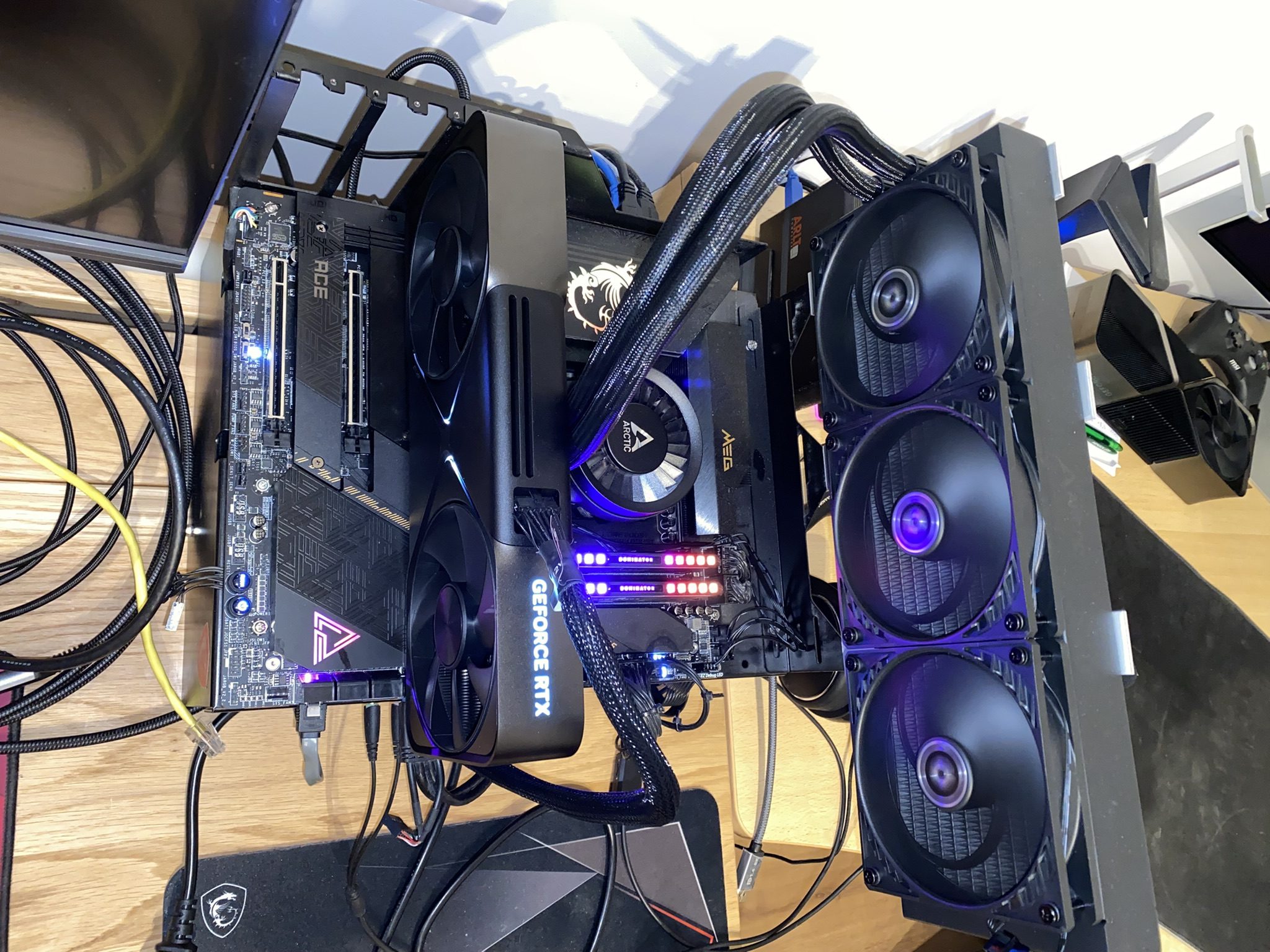
Before we get started, everyone can take a look at my current test system, which I rebuilt at short notice. With my old Intel Core I9-12900K, the CPU bottleneck – even in UHD – is reached faster than you can say Ryzen. That’s why the upgrade was necessary. A big thank you goes to Manu (aka Hardwaredealz), who organized a contact from Dubaro for me. Dubaro was kind enough to lend me an AMD Ryzen 7 9800X3D for three weeks so that the test was possible. So thanks again to Dubaro! If you don’t know anything about Dubaro: Click here!
In the meantime, another AMD Ryzen 7 9800X3D has arrived here, which will also be working for me permanently, as Igor was kind enough to send me one. In order to cool the AMD Ryzen 7 9800X3D better, I also got a new AiO from Arctic and here, too, my thanks go to Arctic for their lightning-fast support. If you don’t know anything about the Arctic Liquid Freezer III: Click here! I have linked the detailed test of the Liquid Freezer III below.
Test system
| CPU |
AMD Ryzen 7 9800X3D |
| Mainboard | MSI MEG X670E ACE |
| RAM | 2x 16 GB Corsair Dominator 6000 MHz CL 30-36-36-76 |
| SSD 1 | Samsung 980 Pro 500 GB (System) |
| SSD 2 | MSI M480 2 TB (games) |
| SSD 3 | HP EX950 2 TB (games) |
| SSD 4 | HP SDD S750 1 TB S-ATA (backup) |
| CPU cooler | Arctic Liquid Freezer III 360 mm |
| Power supply | Seasonic Prime Platinum 1300 Watt |
| GPUs |
NVIDIA GeForce RTX 4090 FE |
| Sound | Onboard |
| Keyboard | ASUS ROG Falchion RX Low Profile (2.4 GHz) @1000 Hz polling rate |
| Mouse | ASUS ROG Harpe Ace Aim Lab Edition (2.4 GHZ) @1000 Hz polling rate |
| Monitor |
Cooler Master Tempest GP27U (IPS MiniLED 3840 x 2160p @ 160 Hz) |
| Software |
Windows 11 24H2 |
Important preface
I test all games exclusively in UHD and with the maximum possible settings. This also means that I set ray tracing to the absolute maximum today. So that we can better assess the performance of the RTX 5090, I put the good old RTX 4090 FE through the test program. Furthermore, I’m going to run all tests in terms of FPS and latency exclusively with the new DLSS Transformer model. This is a real visual improvement.
If you look at the videos later in terms of image quality, please note that I have edited the videos with ICAT and have to upload them to YouTube (compression etc. has an influence here). You must be aware that some image quality is lost and you only see 60 FPS! But I’ve only uploaded videos where I either didn’t find anything to criticize or where I could really notice something – even at high FPS.
But here we go, starting with Alan Wake 2, followed by Cyberpunk 2077 and finally Hogwarts Legacy. These games currently support the new DLSS 4.0 with MFG and we will get a first impression of it today: What DLSS 4.0 can do, where it still has its rough edges and what you need to be aware of with Frame Generation. Here we go!

- 1 - Introduction and test system
- 2 - Alan Wake 2 with DLSS 4.0 - FPS vs. Latenz
- 3 - Alan Wake 2 - Picture quality with DLSS 4.0
- 4 - Cyberpunk 2077 with DLSS 4.0 - FPS vs. Latenz
- 5 - Cyberpunk 2077 - Picture quality with DLSS 4.0
- 6 - Hogwarts Legacy with DLSS 4.0 - FPS vs. Latenz
- 7 - Hogwarts Legacy - Picture quality with DLSS 4.0
- 8 - Summary and conclusion












102 Antworten
Kommentar
Lade neue Kommentare
Urgestein
Veteran
Urgestein
Urgestein
Veteran
1
Urgestein
Veteran
Urgestein
Urgestein
Urgestein
Neuling
Urgestein
Urgestein
Moderator
Moderator
1
Urgestein
Moderator
Alle Kommentare lesen unter igor´sLAB Community →