














Officially, NVIDIA’s Blackwell accelerators are taboo for China. In practice, however, this ban is proving to be surprisingly porous. According to research by the Financial Times, Tencent has secured access to NVIDIA’s current Blackwell generation in a roundabout way, not by purchasing it, but by renting computing power. Legally clean, geopolitically sensitive and strategically highly effective.
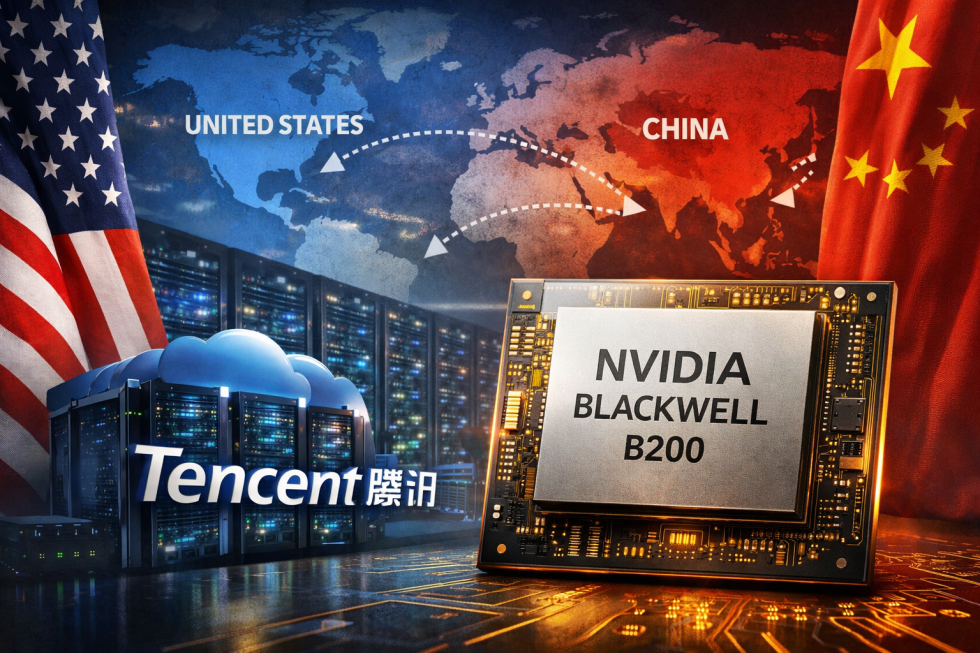
The core of the model is simple. US export controls prohibit the sale and delivery of certain high-performance GPUs to China, but not their use via foreign cloud or rental models. Tencent is exploiting precisely this gray area. The Group uses a third-party provider to access the infrastructure of Japanese neocloud operator Datasection, which operates Blackwell systems in data centers outside of China, primarily in Japan and Australia. According to information from sources close to the contracts, Tencent alone is said to have concluded rental agreements worth over 1.2 billion US dollars. These agreements secure the Group access to a significant proportion of Datasection’s approximately 15,000 Blackwell processors. These include both B200 and B300 variants, i.e. precisely those chips whose export to China was explicitly prohibited by Washington.
From a technical point of view, the action is understandable. Chinese AI companies are under massive computing pressure. Their own chip initiatives have not yet delivered the necessary performance for training modern Foundation and Frontier models. At the same time, even NVIDIA variants released specifically for China are clearly limited. Blackwell is in a different league here, both in terms of memory bandwidth as well as scaling and efficiency. According to the FT, an analyst from Bernstein Research puts it in a nutshell. For Chinese companies, the rental model is more attractive in the long term than buying slimmed-down GPUs domestically. The available computing power is significantly higher than what the domestic market or export-compliant products can offer. Even compared to the Hopper generation, Blackwell is clearly superior. Tencent is not alone in this. Alibaba and Baidu have also been relying on outsourced computing capacities for some time. The goal is identical. Access to state-of-the-art US technology without breaking the formal export barriers. This is an uncomfortable reality for Washington. The ban looks tough on paper, but loses its impact as soon as computing power is traded as a service.
Politically, this is a double-edged sword. On the one hand, the export rules remain formally intact. On the other hand, it is clear that technological dependencies are not only decided via supply chains, but also via usage models. If you rent compute, you don’t need chips in the country. Control is shifting from hardware to infrastructure.
The bottom line is that the Tencent case reveals less a Chinese loophole than a structural problem with Western export policy. As long as high-performance computing can be rented globally, chip embargoes are not a technological barrier, but at best a speed limit. Blackwell is up and running, just not where Washington originally wanted it to be.
| Source | Key message | Link |
|---|---|---|
| Financial Times | Tencent uses third-party leased computing capacity from Datasection with NVIDIA Blackwell B200 and B300 chips outside China to circumvent US export restrictions. | https://www.ft.com/content/0f6f3c6e-8a8b-4f4b-9e4f-0a6c0e3e8f6a |
| Financial Times | Datasection has around 15,000 NVIDIA Blackwell processors in data centers in Japan and Australia and has signed multi-billion dollar leases with a major customer. | https://www.ft.com/content/0f6f3c6e-8a8b-4f4b-9e4f-0a6c0e3e8f6a |
| NVIDIA | Blackwell is NVIDIA’s latest GPU architecture for AI training and inference with significantly higher performance than Hopper. | https://www.nvidia.com/en-us/data-center/blackwell-platform/ |
















1 Antwort
Kommentar
Lade neue Kommentare
Mitglied
Alle Kommentare lesen unter igor´sLAB Community →