














The celestial body PSR J2322-2650b, which was studied with the help of the James Webb Space Telescope, is one of the most unusual exoplanets observed to date. It does not orbit a normal star, but a pulsar, i.e. a rapidly rotating neutron star that was formed as the remnant of a supernova. This constellation alone contradicts classical ideas of stable planetary systems, as pulsars are considered to be extremely radiation-intensive and hostile environments.
The observed shape of the object deviates significantly from the usual spherical shape. Due to the extremely small distance to the pulsar, strong tidal forces are at work, visibly stretching the planet. Model calculations and observational data indicate that the orbital period is only around 7.8 hours. The resulting deformation leads to a strongly ellipsoidal shape, colloquially described as lemon-shaped.
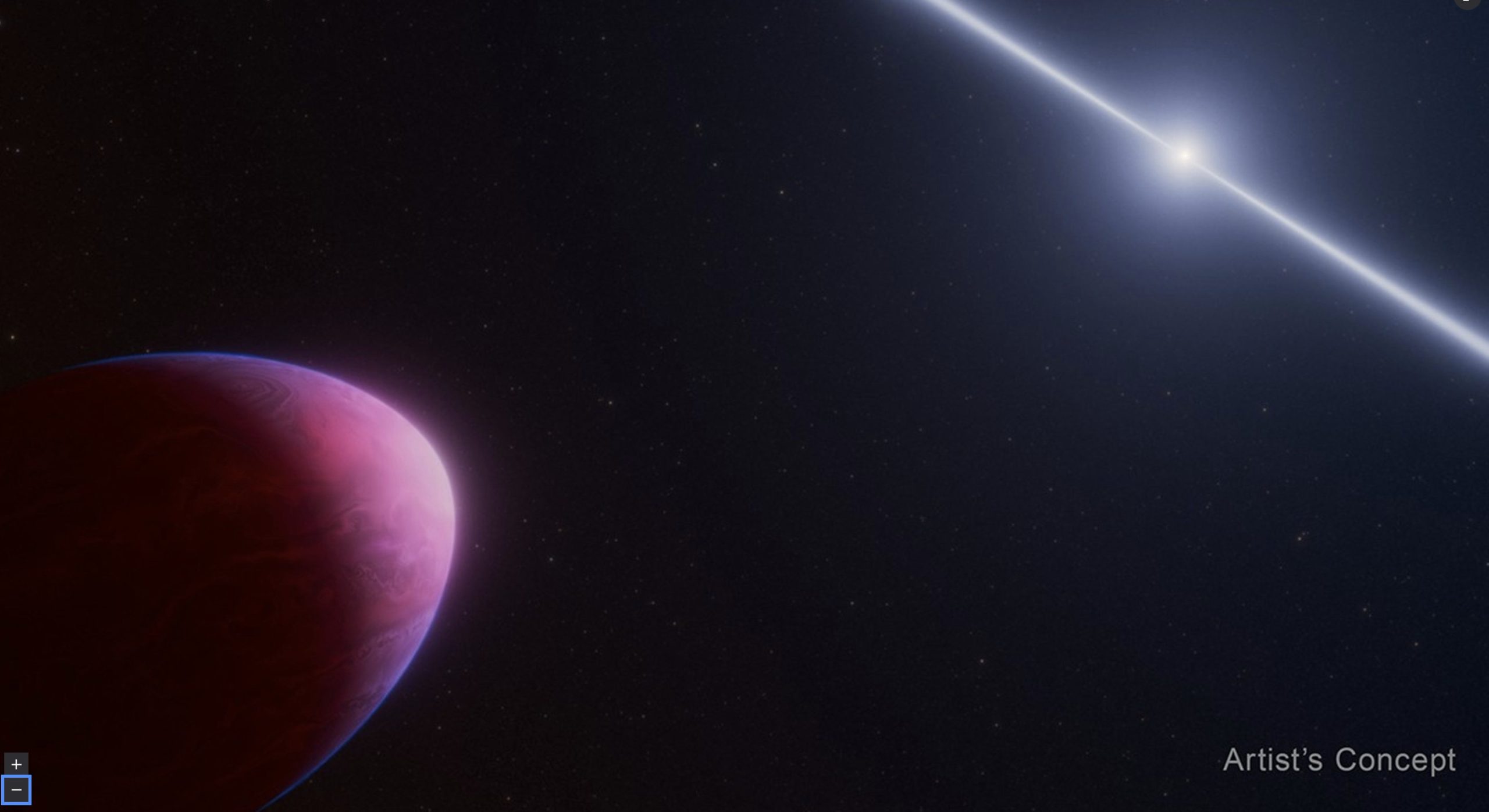
The chemical composition of the atmosphere is particularly striking. While gas giants are usually dominated by hydrogen and helium, the spectral data here show an atmosphere consisting almost entirely of heavy elements. Molecular carbon compounds such as C₂ and C₃ were primarily detected. Common molecules such as water, methane or carbon dioxide are largely or completely absent. This composition is considered unusual under the prevailing temperatures of several hundred to over two thousand degrees Celsius, as carbon normally forms other chemical bonds under such conditions.
The possible internal structure of the planet is also a source of debate. Under the enormous pressure in the interior, carbon layers could have formed that are present in solid phases. Theoretical models allow for the formation of diamond-like structures, but this has not yet been directly observed or experimentally confirmed. Corresponding statements are therefore based on physical high-pressure models and remain hypothetical.
The formation history of PSR J2322-2650b cannot currently be explained conclusively. Neither the classical scenario of planet formation from a protoplanetary disk nor the assumption of a strongly ablated stellar remnant provides a consistent explanation for the observed combination of mass, composition and orbit. Even known processes of nuclear physics offer no established mechanism that would explain an almost pure carbon-helium composition without any significant oxygen content.
Historically, pulsar planets were the first exoplanets ever discovered, but they are still considered extremely exceptional cases. The planet now analyzed expands this picture considerably, as it shows that complex and previously unexpected planet-like objects can exist even in the remnants of massive stellar explosions.
Conclusion
The observation of PSR J2322-2650b illustrates that the current understanding of planet formation and planetary chemistry is incomplete, especially in extreme environments such as pulsar systems. The exoplanet combines several features, each of which is unusual in its own right, but the combination of which has so far remained without a conclusive explanation. These include the highly deformed shape due to extreme tidal forces, the extremely short orbital period and an atmospheric composition dominated by heavy elements and molecular carbon and almost devoid of classical planetary molecules.
The data suggest that known models based on the formation from protoplanetary disks or heavily ablated stellar remnants are not sufficient to consistently explain this object. The absence of oxygen and nitrogen in significant quantities is particularly problematic, as these elements inevitably occur in almost all known planetary and stellar evolutionary processes. The existence of such a body suggests that there must be alternative formation or evolutionary pathways that have either been theoretically underestimated or not considered at all.
Furthermore, the case of PSR J2322-2650b demonstrates the particular scientific value of observations in pulsar systems. As the central star hardly emits any radiation in the infrared range, planetary atmospheres can be studied with unprecedented precision. This opens up new possibilities for identifying exotic chemical processes and systematically testing the limits of known physical models.
Overall, this exoplanet underlines that planet-like objects can also form or persist under conditions that were long considered completely unsuitable. The discovery not only expands the known spectrum of planetary appearances, but also forces astronomy to re-evaluate its theoretical basis for extreme systems.
| Source | Key statement | Link |
|---|---|---|
| NASA Science | Official NASA presentation of the JWST observations, description of the unusual atmospheric chemistry of PSR J2322-2650b, classification of the results as not compatible with established formation models | https://science.nasa.gov/missions/webb/nasas-webb-observes-exoplanet-whose-composition-defies-explanation/ |
| University of Chicago News | University announcement of the research team involved, focus on lemon shape due to tidal forces, carbon dominance of the atmosphere and observations in the pulsar system | https://news.uchicago.edu/story/nasas-webb-telescope-finds-bizarre-atmosphere-lemon-shaped-exoplanet |
| Space.com | Summarizing technical article with information on orbital period, temperature range, atmospheric composition and significance for exoplanet research | https://www.space.com/astronomy/exoplanets/james-webb-space-telescope-discovers-a-lemon-shaped-exoplanet-unlike-anything-seen-before-what-the-heck-is-this |
| Scientific American | Scientific classification of the discovery, analysis of the chemical peculiarities and the theoretical problems for existing models of planet formation | https://www.scientificamerican.com/article/scientists-are-baffled-by-this-bizarre-lemon-shaped-exoplanet/ |
| Engadget Science | Technically oriented summary of the observations, focus on JWST measurement methods, pulsar planets as a special case and the importance of infrared spectroscopy | https://www.engadget.com/science/space/astronomers-find-mysterious-lemon-shaped-exoplanet-with-nasas-webb-telescope-223722244.html |

























Kommentieren