














NVIDIA’s dominance in the AI market is beginning to show serious cracks. After years of undisputed market leadership in training hardware for neural networks, the competition is slowly but dangerously tightening. According to a report by The Information, Amazon is planning to invest up to 10 billion US dollars in OpenAI on the condition that OpenAI uses Amazon’s own Trainium ASICs. At first, this sounds like a deal between two giants, but in reality it is a geopolitical proxy war for the future of the AI data center.
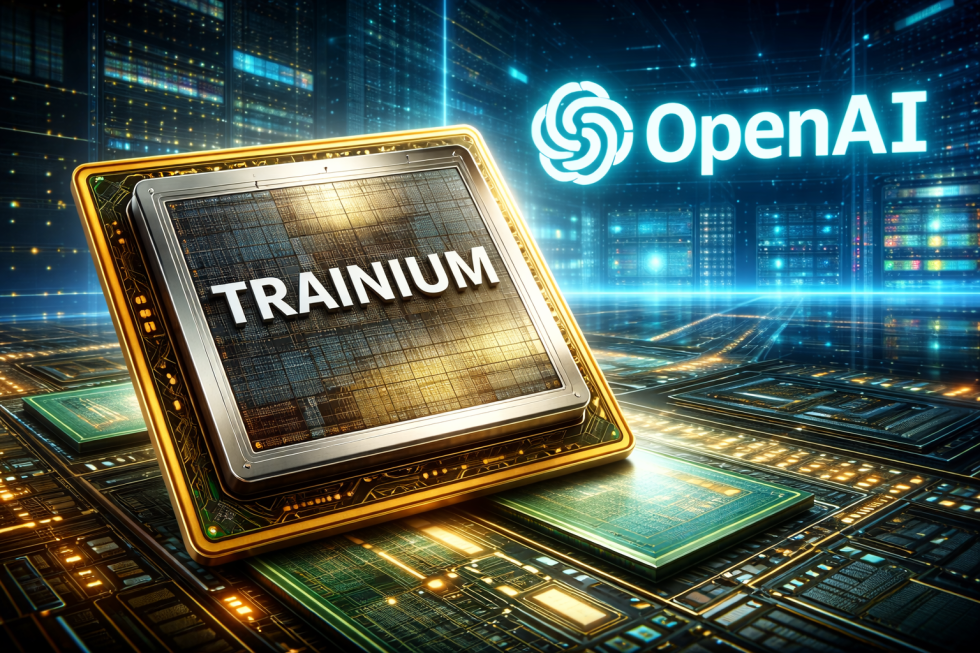
Amazon’s Trainium: from niche product to strategic weapon
Amazon’s Trainium chips, now in their fourth generation (Trainium4), were originally developed for AWS-internal workloads. The move to make them available externally on a large scale – and then to OpenAI of all places – is more than just an expansion: it is an announcement. While Google has been pursuing a parallel strategy with its TPUs for years, Amazon has so far been more cautious. However, the latest rack-scale integration of Trainium3 shows that Amazon no longer wants to be just a cloud provider, but an infrastructure powerhouse. With 3 nm manufacturing, 40% higher energy efficiency and twice the computing power of its predecessor, the new Trainium ASICs are clearly aimed at NVIDIA’s Hopper and Blackwell series. From a technical perspective, this is a frontal attack on the GPU monopoly; from a business perspective, it is an attempt to emancipate itself from the costly CUDA ecosystem. Every GPU that can be replaced saves billions in operating costs.
OpenAI between capital requirements and technological pragmatism
OpenAI is in a precarious position: going public is expensive and growth eats up capital. An external financial injection of 10 billion US dollars provides breathing space, but it ties the company down technologically. Amazon’s condition, the use of Trainium, is clever. OpenAI receives the necessary infrastructure and liquidity, while Amazon finally gains a flagship customer for its chips. This also shifts the balance of power in the background. Until now, NVIDIA has benefited from an alliance with Microsoft and OpenAI, which pumped billions into GPU-based superclusters. If OpenAI focuses on Trainium in parallel in future, this will significantly weaken NVIDIA’s strategic position. Dependence on the green giant would decrease, and this is exactly what Amazon (and indirectly Google) are aiming for in the long term: Deconstruction of GPU supremacy.
The silent front of the chip war
The race for AI chips is no longer a classic competition, but a proxy war between cloud giants. Amazon and Google are focusing on vertical integration (own chips, own clouds, own software), while NVIDIA is countering with software lock-in (CUDA, TensorRT, DGX ecosystem). OpenAI acts as a coveted token here: whoever supplies OpenAI with hardware indirectly dictates the standards of tomorrow’s AI infrastructure. The fact that OpenAI is now negotiating in parallel with Microsoft, NVIDIA, AMD, Broadcom, Amazon and others shows how much it wants to break free from the grip of a single supply chain. A step that is only logical in view of geopolitical tensions (e.g. around Taiwan) and growing regulatory risks.
Conclusion: a strategic reorganization
The potential use of Amazon’s Trainium in OpenAI would not just be “another deal”, but a tectonic plate shift in the AI industry. NVIDIA remains the leader in the short term, but the industry’s structural dependency is beginning to crumble. Amazon’s billion-dollar offensive is the first credible signal of a multipolar future in which AI no longer rests on a single GPU giant, but on multiple ASIC pillars.
If OpenAI really does deploy these chips on a large scale, it will not only be to save costs, but to demonstrate political and technological independence. NVIDIA may still hold the sceptre, but Amazon has long since begun to chip away at its throne.
| Source | Key message | Link |
|---|---|---|
| The Information | Amazon plans to invest around 10 billion US dollars in OpenAI, coupled with the use of Trainium ASICs | https://www.theinformation.com/articles/amazon-to-invest-10-billion-in-openai-in-trainium-chip-deal |
| Wccftech | Report on Amazon’s negotiations with OpenAI for external use of Trainium ASICs | https://wccftech.com/nvidia-ai-chips-might-have-a-new-challenger-onboard-and-no-its-not-google-openai-plans-to-deploy-amazons-trainium-asic-in-a-mega-deal |
| Amazon AWS Blog | Technical details on Trainium3 and announcement of the rack-scale architecture | https://aws.amazon.com/blogs/machine-learning/introducing-aws-trainium3-accelerator-for-ai-training |
| NVIDIA Investor Relations | Statement from the CFO on the irreplaceability of the NVIDIA AI stack | https://investor.nvidia.com/news-releases/news-release-details/nvidia-cfo-on-asic-competition-ai-stack-2026 |




















5 Antworten
Kommentar
Lade neue Kommentare
Veteran
Mitglied
Mitglied
Mitglied
Urgestein
Alle Kommentare lesen unter igor´sLAB Community →