














The headline sounds almost like science fiction, but it is bitter reality: with the upcoming SP7 platform, AMD is planning server processors that will consume up to 1,400 watts of power – per socket, mind you. This doubles the TDP compared to the current SP5 platform, which is already at 700 watts with Zen 4-based EPYC processors. This leap in performance is made possible by the Zen 6 architecture, codenamed “Venice”, which not only offers more cores and cache, but apparently also breaks all previously known thermal limits. Why this change of course? Quite simply, the demand for pure computing power – especially in the AI environment – is increasing exponentially, while GPUs and special accelerators dominate, but cannot handle every task on their own. AMD is therefore strategically positioning itself aggressively in the CPU market in order to play a dominant role in AI inference, database processing and virtualization. However, anyone hoping for efficiency will be disappointed. SP7 is not an architectural marvel with low power dissipation, but a brute power monster that sets new standards – also in terms of the electricity bill.
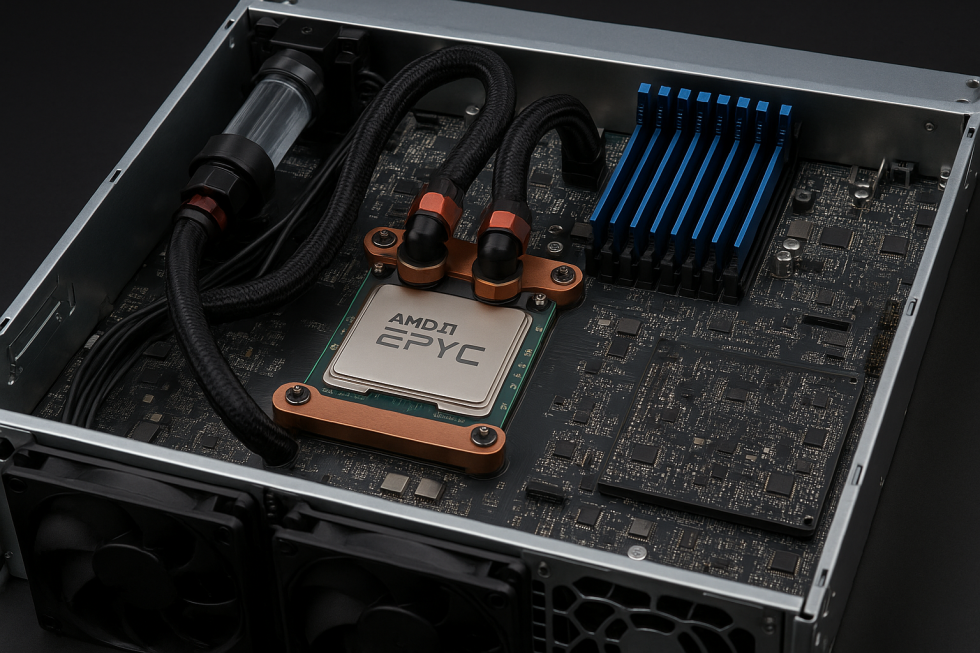
Interestingly, the cooling of this computing monster does not come from AMD itself, but from third-party suppliers such as Taiwan Microloops, who are working on a dual-loop liquid cooling system. This system is based on direct contact with the heatspreaders and pumps several liters of cooling liquid per minute through specially manufactured heat sinks. Air cooling? Completely out of the question. At 1,400 watts, we are talking about thermal density that is otherwise only found in industrial melting processes – or in overclocked mining farms just before they go up in flames. This naturally raises questions: How realistic is the use of such CPUs in traditional data centers? Can cloud providers such as AWS or Microsoft Azure even provide the necessary infrastructure to operate this type of processor economically? The answer is a clear “no”. Large providers with modern liquid cooling and redundant power supply will probably pilot this platform – smaller operators, on the other hand, will have to stay outside. This is because the technical overhead caused by cooling, power supply units, power supply and maintenance requirements is likely to drive the entry costs to absurd heights.
One could argue that AMD is delivering a technological demonstration of power here – a kind of prestige project to put further pressure on Intel in the data center. While Intel tends to rely on conservative TDP values and special accelerators with its Xeon chips, AMD is taking the brute route: more cores, more clock speed, more heat. And those who can’t handle it should stay outside. The SP7 platform thus becomes a symbol of the paradigm shift in the server industry: efficiency is no longer the highest goal – but density, performance and maximum computing capacity per square meter of rack space. And if a CPU socket draws more power than an entire household, then so be it. The market logic is brutal, and AMD knows that. Whether this is sustainable in the long term remains to be seen. On the one hand, the hunger for performance of modern AI models is real; on the other hand, regulatory and social pressure to promote energy-efficient IT infrastructures is growing. The SP7 platform is therefore a double-edged sword: technically fascinating, but a nightmare in terms of infrastructure. If it succeeds, it could massively change the data center architecture of the next few years – if not, it will be remembered as an overbred example of what happens when you ignore thermal physics and just look at the data sheet instead.













5 Antworten
Kommentar
Lade neue Kommentare
Urgestein
Urgestein
Urgestein
Mitglied
Urgestein
Alle Kommentare lesen unter igor´sLAB Community →