















The Arc Pro B50, officially launched today, positions itself directly against AMD’s Radeon Pro W7500 and NVIDIA’s RTX A1000 in the entry-level segment of professional workstations. The focus is on compact systems with ISV certifications, low power consumption and predictable behavior. A key differentiating feature is the memory expansion of 16 gigabytes, which promises clear advantages in memory-bound DCC scenes, with large texture sets and local AI inference. Although the power consumption is likely to be more on a par with the W7500 and above the RTX A1000, modern display and media functions including DisplayPort 2.1 and AV1 codec for multi-monitor setups as well as editing and transcoding workflows speak for themselves. In terms of price, the card is aimed below the Radeon Pro W7500 and within reach of the RTX A1000. Experience has shown that concrete street prices fluctuate depending on the region and time, but we know that.
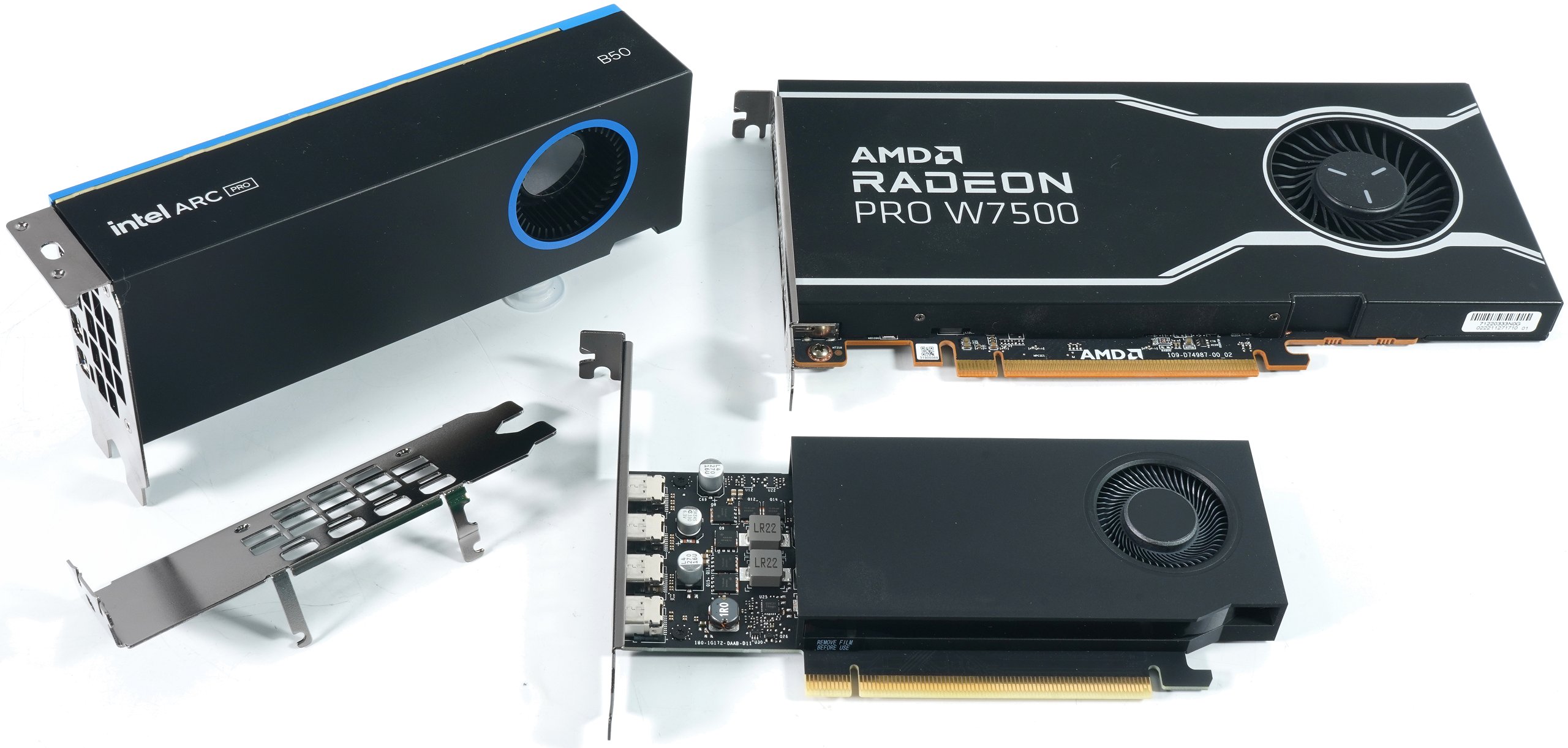
But who needs a new entry-level card like this anyway? Teams that need small, quiet workstations with four high-resolution display outputs, stable ISV drivers and large local memory, for example for architectural visualization, design and engineering projects, video editing with modern codecs or reproducible AI inference without a cloud, are likely to benefit. The card appears less suitable where specific CUDA extensions or workloads closely aligned to other ecosystems dominate.
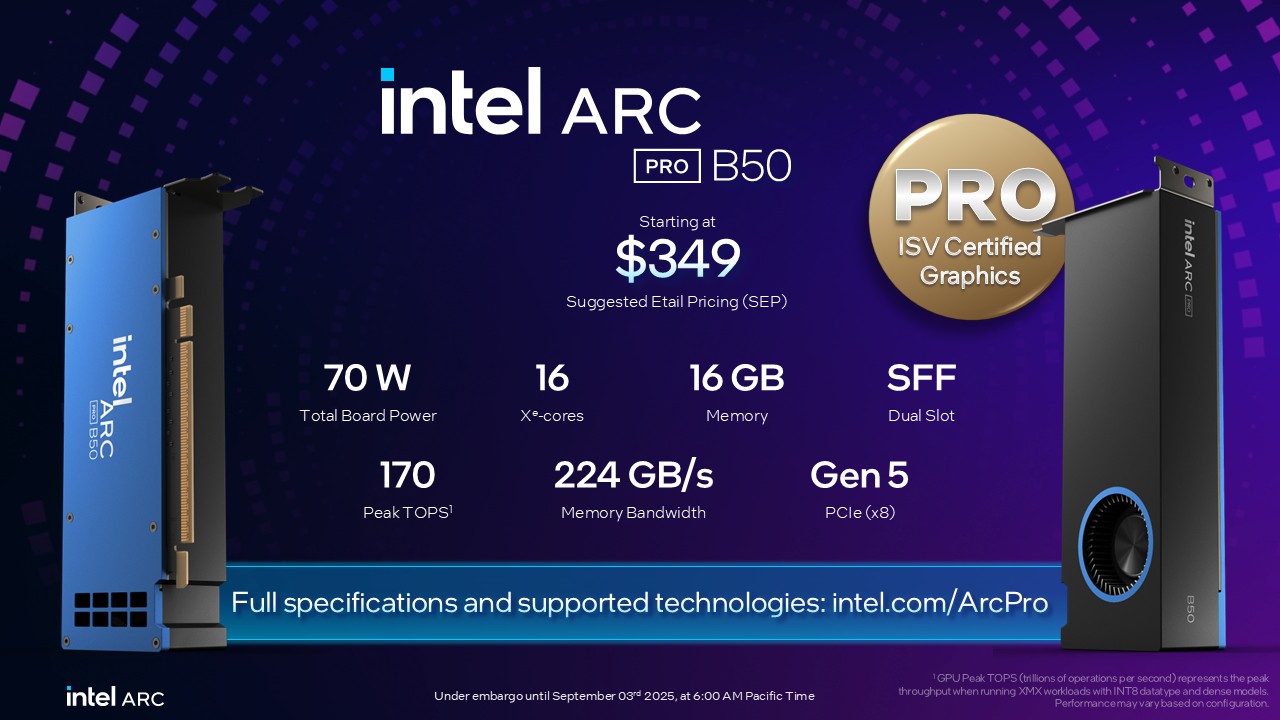
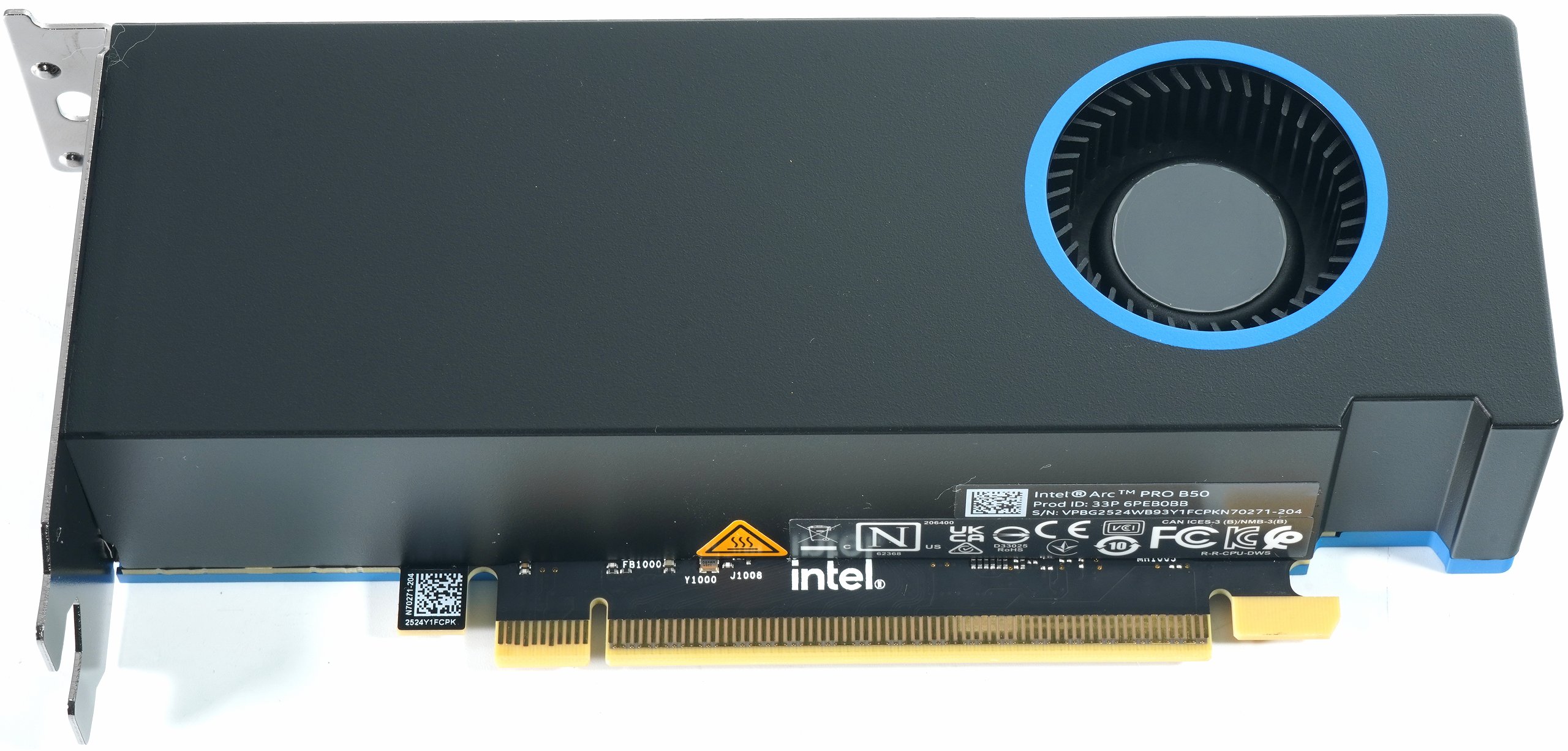
Today’s test classifies the Arc Pro B50 as a compact workstation graphics card for design- and engineering-related workflows, including architecture, visualization and local AI inference, where certified drivers, predictable behavior and low power consumption are more important than maximum gaming frame rates. The card is based on the BMG-G21 of the Xe2 generation, offers 16 Xe cores with XMX acceleration and relies on 16 gigabytes of GDDR6 on a 128-bit interface with a nominal bandwidth of 224 gigabytes per second. The connection is made via PCI Express 5.0 with eight lanes, the typical board power consumption is specified at 70 watts. The information on a recommended entry-level price of 349 US dollars still has to be proven in reality, as the usual surcharges are added on top.
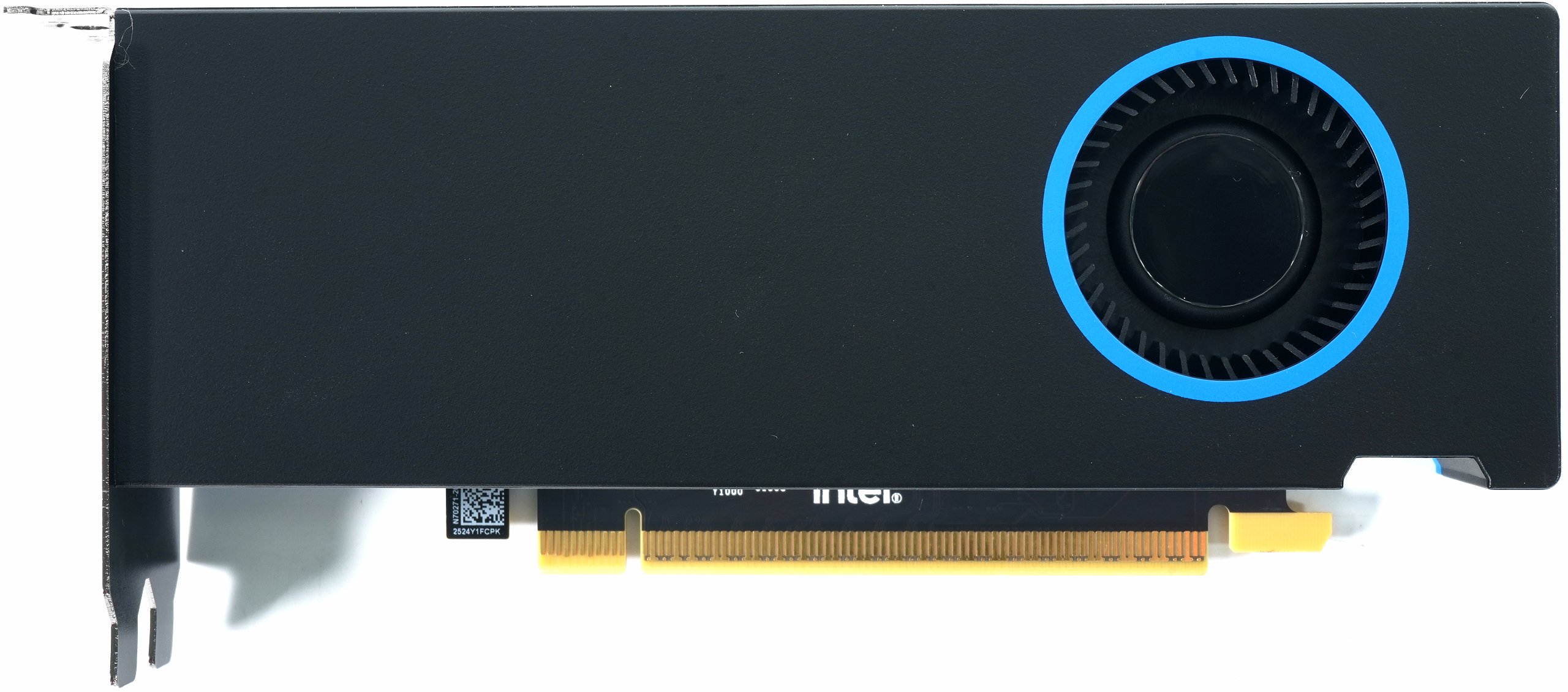
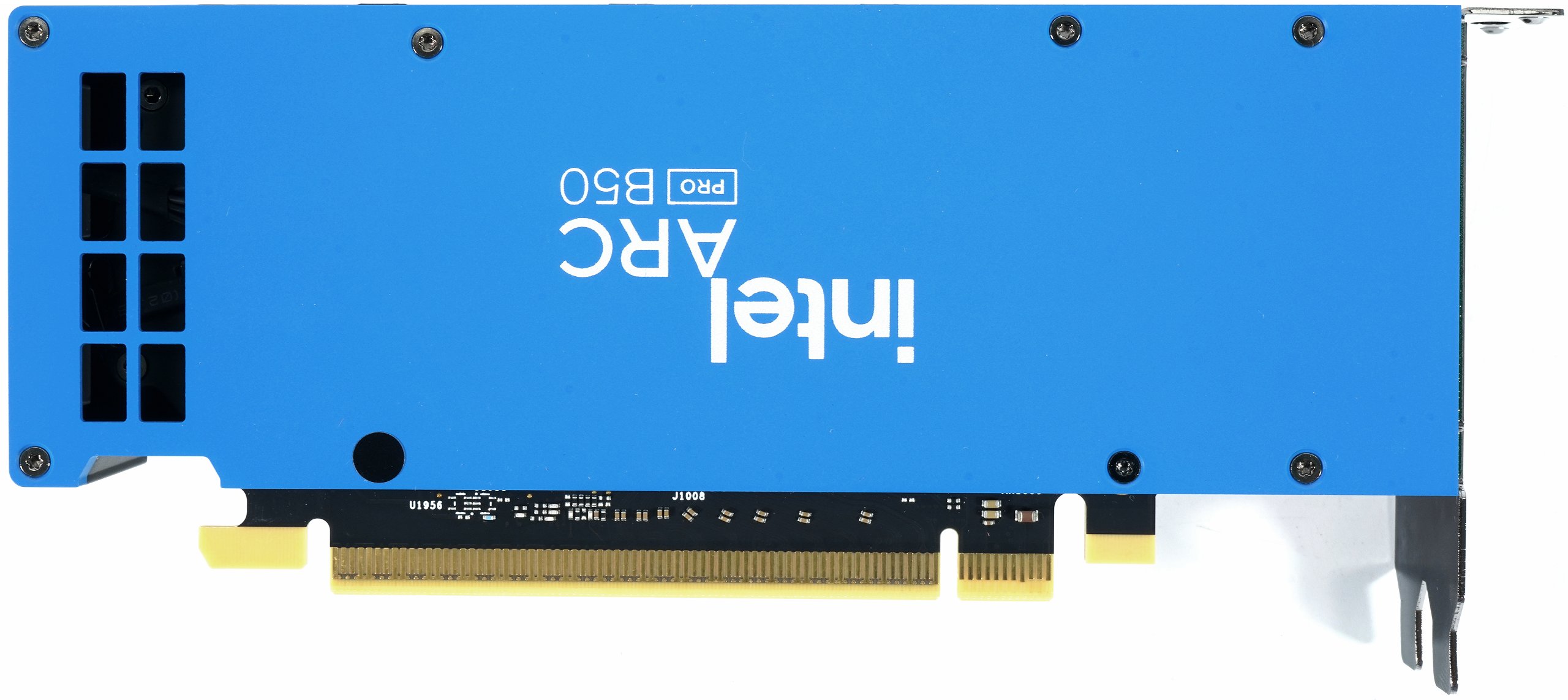
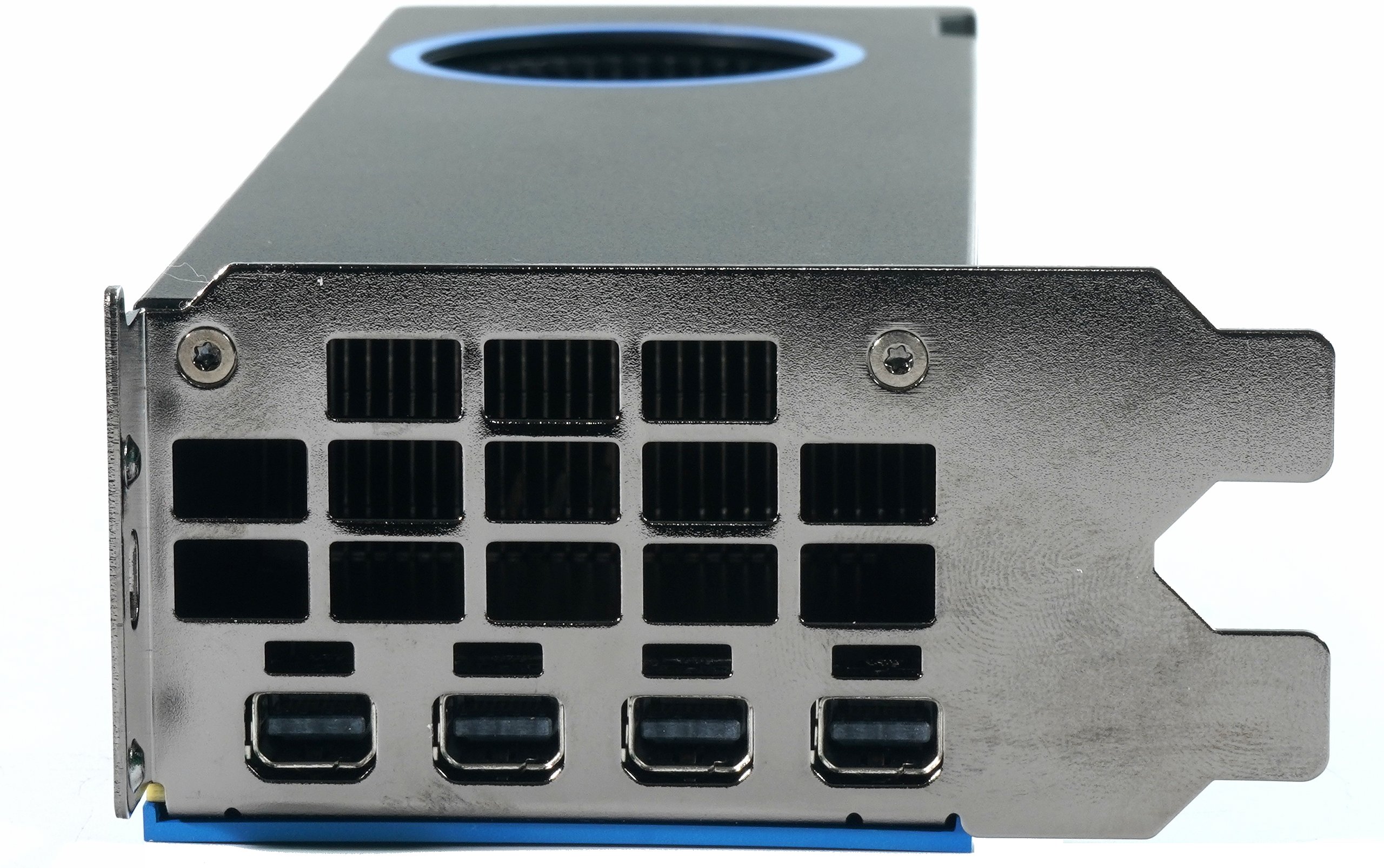
The reference design of the Arc Pro B50 is a dual-slot, low-profile card in half-height, half-length. The specified external dimensions are 168 millimeters in length and 69 millimeters in height, which corresponds to 6.6 inches by 2.7 inches. These dimensions apply to the Intel card, partner designs may of course differ. The reference card weighs 330 grams. It should also be mentioned that no additional power connector is required, which contributes to easy installation in compact workstations.
Four Mini-DisplayPort 2.1 outputs are available, with the port labeled as primary supporting UHBR 13.5; appropriately certified cables are required for the full data rate. On the media side, a dual MFX engine is used, which supports hardware encode and decode including AV1 and HEVC 4:2:2 in 10-bit. An Arc Pro driver with ISV focus and regular function updates via the Arc Gaming branch are provided for professional environments, telemetry and setting options are bundled in the current Intel graphics software, including a switchable ECC option.
The test focuses on practical performance evaluation and covers the typical application areas of creation, design, rendering and visualization. Full versions of Solidworks, PTC Creo, AutoCAD, Inventor Professional and Autodesk Maya are tested, supplemented by the usual SPEC workloads and the PugetBench suites for DCC and video. The aim is a reliable classification of the card in real project scenarios with reproducible measurement runs, identical project settings and clearly identified driver profiles.
The measurements in the CAD and DCC applications follow project-related workflows, such as complex assemblies in Solidworks and Creo, parametric modeling in Inventor, viewport interaction and playback in Maya as well as 2D to 3D transitions in AutoCAD. SPEC provides device-independent profiling of viewport performance in the relevant scenes, PugetBench supplements this with practical pipelines for image processing, photo catalogs and editing, allowing the interactivity of the system and export performance to be objectively mapped. All software statuses, presets and scenes are documented in the test log, deviations are highlighted and unverifiable information is clearly marked as such.
For rendering and visualization, the test evaluates both raster and raytracing workloads in the viewport as well as offline renders. The display configuration with high resolutions and variable refresh rates is also tested under load, as bandwidth and timing can have measurable effects in complex setups. AI performance is evaluated independently and in detail. Standardized inference measurements with common suites for image and text tasks are planned, as well as throughput and latency over different precisions with special attention to quantized INT8 and BF16 paths, if available.
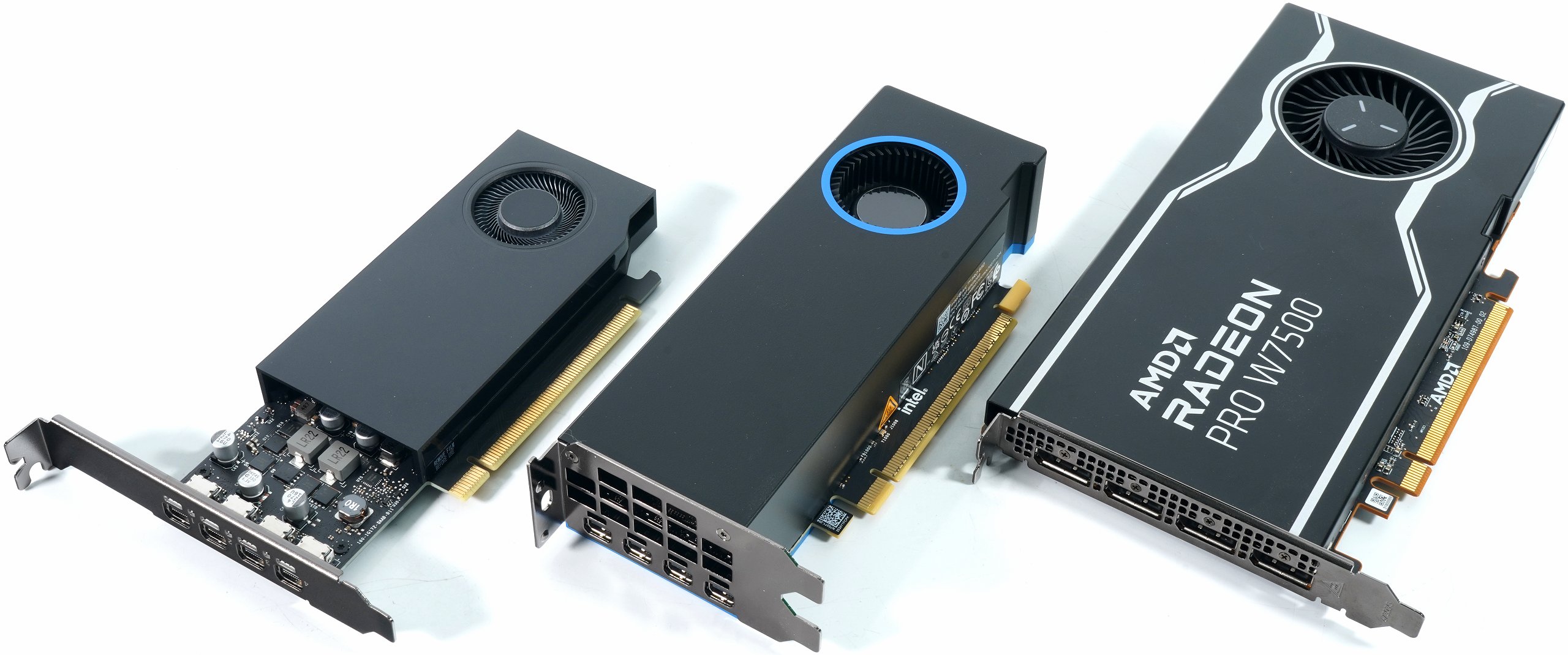
In addition to the benchmarks, I also provide a very detailed teardown, which also includes the material analysis and the evaluation of the thermal interface material (TIM). In this form, this is probably the only test today that contains such information at all. And to warm up for today’s triathlon, here’s the obligatory table:
| Feature | Intel Arc Pro B50 | AMD Radeon Pro W7500 | NVIDIA RTX A1000 |
| Architecture | Intel Xe2 (BMG-G21) | AMD RDNA 3 | NVIDIA Ampere |
| Computing units | 16 Xe cores, 16 RT cores | 28 CU, 28 RT cores | 18 SM, 18 RT cores |
| Memory size | 16 GB | 8 GB | 8 GB |
| Memory type | GDDR6 | GDDR6 | GDDR6 |
| Memory interface | 128 bit | 128 bit | 128 bit |
| Memory bandwidth | 224 GB/s | 173 GB7s | 192 GB/s |
| PCIe | PCIe 5.0 x8 | PCIe 4.0 x8 | PCIe 4.0 x8 |
| Power consumption (TBP) | 70 W | 70 W | 50 W |
| Additional power connector | none | none | none |
| Display outputs | 4× mini-DisplayPort 2.1 | 4× DisplayPort 2.1 | 4× mini-DisplayPort 1.4a |
| Display bandwidth | Port 1 UHBR 13.5, others UHBR 10 | UHBR 10 on all ports | HBR3 with DSC |
| Max. Output configuration | up to 8K60 HDR or 4× 4K120 HDR | up to 2× 8K60 or 4× 4K | up to 4× 4K (DP 1.4a, DSC) |
| Media engine | AV1 encode/decode, HEVC 4:2:2 10-bit, H.264, VP9 | AV1 Encode/Decode, HEVC, H.264 | AV1 Decode, HEVC/H.264 Encode/Decode |
| Form factor | SFF, dual-slot, low-profile and full-height bezels | Single-slot, full-height | Single-slot, low-profile |
| Dimensions (LxH) | approx. 168 × 69 mm | approx. 216 x 115 mm | approx. 163 x 69 mm |
| Drivers | Arc Pro Workstation, regular Arc updates, ECC switchable | Radeon Pro Enterprise | NVIDIA RTX Enterprise |

- 1 - Introduction, unboxing and technical data
- 2 - Test system and equipment
- 3 - Teardown: PCB, topology and components
- 4 - Teardown: Cooling solution
- 5 - Teardown: Material analysis and ASTM TIM testing
- 6 - Autodesk AutoCAD
- 7 - Autodesk Inventor Pro
- 8 - PTC Creo
- 9 - Dassault Systèmes Solidworks
- 10 - Autodesk Maya
- 11 - SPECviewperf 15 (2025)
- 12 - Adobe Photoshop 26.10
- 13 - Adobe After Effects 2025
- 14 - Adobe Premiere Pro 25.41
- 15 - AI Benchmarks (AI Vision, Image, Text)
- 16 - Rendering
- 17 - Temperatues, clock rates, power draw and fan speed
- 18 - Summary and conclusion












32 Antworten
Kommentar
Lade neue Kommentare
Urgestein
Veteran
1
Urgestein
1
Urgestein
1
1
Urgestein
1
Urgestein
1
Urgestein
1
Urgestein
Urgestein
Urgestein
Veteran
1
Alle Kommentare lesen unter igor´sLAB Community →