















The new ARCTIC MX-7 is a consistent further development of a paste series that has been shaping the market for many years in a rather inconspicuous but technically relevant segment. ARCTIC focused early on creating uncomplicated yet reproducible solutions for users who require reliable thermal bonding without having to deal with exotic formulations or short-lived trends. This is precisely why the MX series has a remarkable continuity that can be traced from the first widespread adoption of the MX-2 to today’s MX-7. Back then, the MX-2 was representative of the approach of offering an electrically non-conductive, silicone-based paste with a fine, uniform particle distribution, where ageing stability was more important than the theoretically highest thermal conductivity value. The MX-4 followed this concept but relied on an even more stable matrix and thus established itself over many years as an all-purpose solution for radiator manufacturers, system integrators and users who valued low-maintenance operation. MX-5 and MX-6 subsequently marked a change to more modern fillers and modified rheological properties, with MX-6 in particular clearly demonstrating that ARCTIC was able to achieve significant improvements in the area of processing properties. The finer-grained structure, the more homogeneous application and the more controlled formability were examples of this step.
With the MX-7, ARCTIC is now taking this line further and positioning the paste as a compound that is geared more towards the current requirements of modern processors and GPUs. The combination of increasing surface loads, smaller chiplet structures and increasingly complex heatspreader geometries requires pastes that work with low base tolerances as well as with higher mechanical loads at certain points. I therefore expect a paste that focuses less on theoretically maximum thermal conductivity values and more on consistent performance with changing contact pressures, stable friction values and the lowest possible pump-out tendency over the entire service life. Let’s see…
ARCTIC as a company reflects this evolution. Since its foundation, the company has worked with a clear technical focus and deliberately avoided excessive diversification. Fans, coolers and the associated thermal materials have formed the core portfolio for years. The manufacturer benefits from a comparatively lean structure and short development paths, which in the past has repeatedly led to products such as the MX series being maintained and adapted over many cycles without losing their fundamental character. This continuity is a key reason why the brand has been able to maintain a steady presence in the thermal sector, both in the OEM environment and in the end customer market.
The MX-7 is now entering a phase in which thermal pastes have to cope with much more demanding conditions. Higher power densities, varying contact pressure mechanics and the increasing shift to heterogeneous chiplet layouts require paste behavior that goes beyond classic parameters such as thermal conductivity. I therefore see the MX-7 as the next logical step in a series whose history is closely linked to the general development of modern cooling systems. It forms a new reference point within a portfolio that has established itself over more than a decade as a robust and practical solution.
If there happens to be a chemist among the readers or someone who has close connections to a suitable laboratory, I would of course be very happy to hear from them.
ARCTIC has deliberately positioned the paste in the lower to medium price segment. The official MSRP is between €14.49 for the 2g version and €20.99 for the 8g syringe, depending on the pack size. However, a significantly lower price level is already apparent in the usual online channels at market launch. On Amazon and eBay, the same variants are offered at significantly lower prices, usually in the range of around eight to eleven euros, depending on the filling quantity and current availability. It can be assumed that these market prices will be transferred to other retailers just as quickly, as ARCTIC products are usually widely distributed and price adjustments in the accessories segment take place quickly.
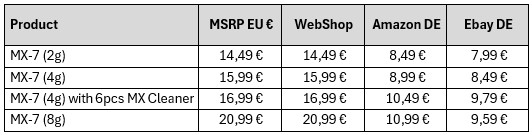
This makes the MX-7 a very competitive offering, despite its technical advancement and a performance that is clearly at the top of oxide-based pastes. For many users, this ratio of performance to real street price is likely to be a decisive factor, as the paste tends to compete with mid-range products in terms of price, but delivers values that are closer to the higher-priced TIMs in many areas.
Unboxing, pack sizes and accessories
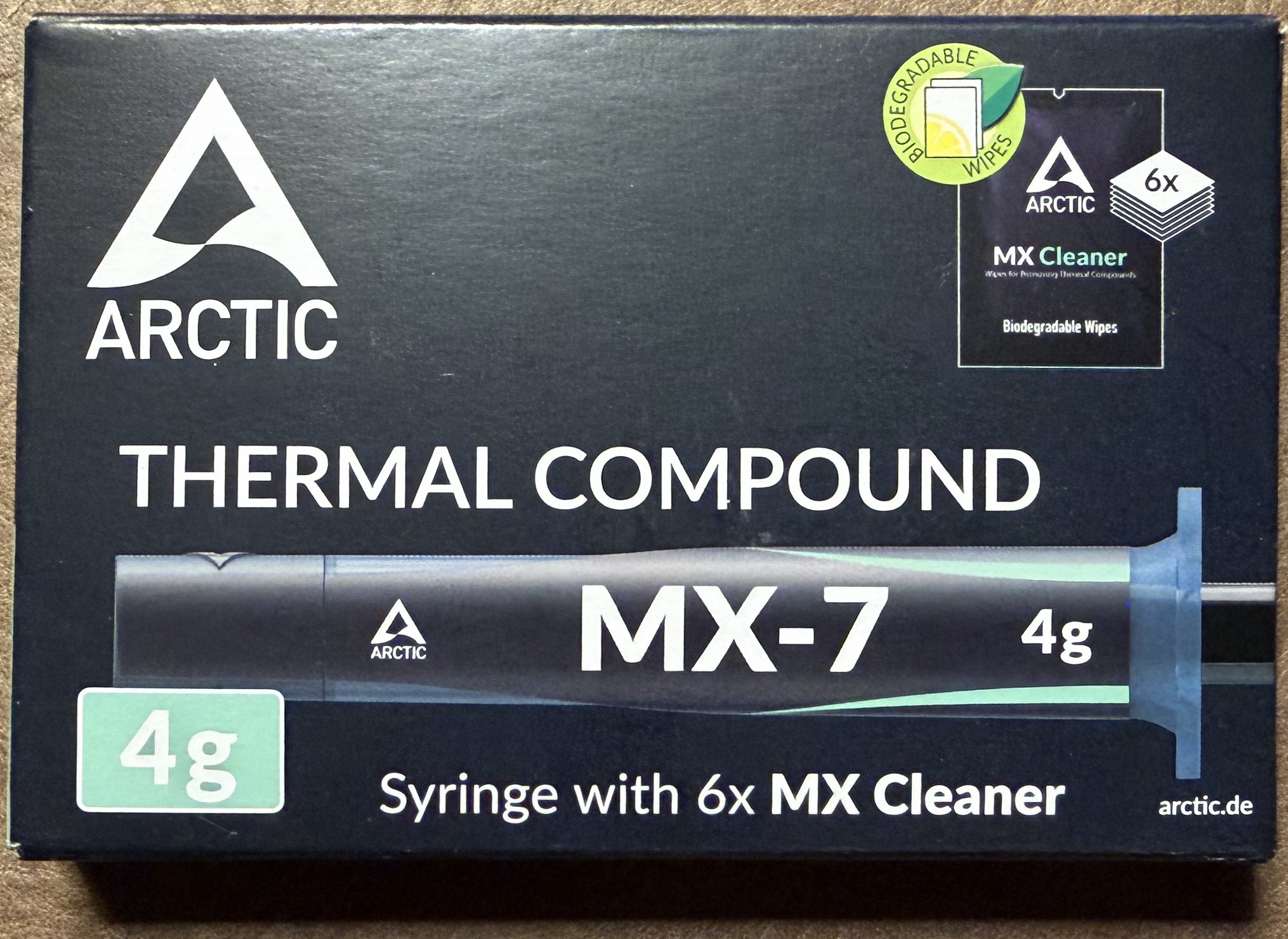
When opening the MX-7, it is immediately apparent that ARCTIC is continuing its packaging concept consistently and focusing heavily on functionality. The box has a sturdy, functional design and clearly communicates what you are getting from the outside. The 4 g version with the enclosed MX Cleaner wipes stands out visually, as ARCTIC offers a complete set for preparing and applying the paste. This format is aimed at users who want to carry out more than just a single assembly and prefer a clean, reproducible application.
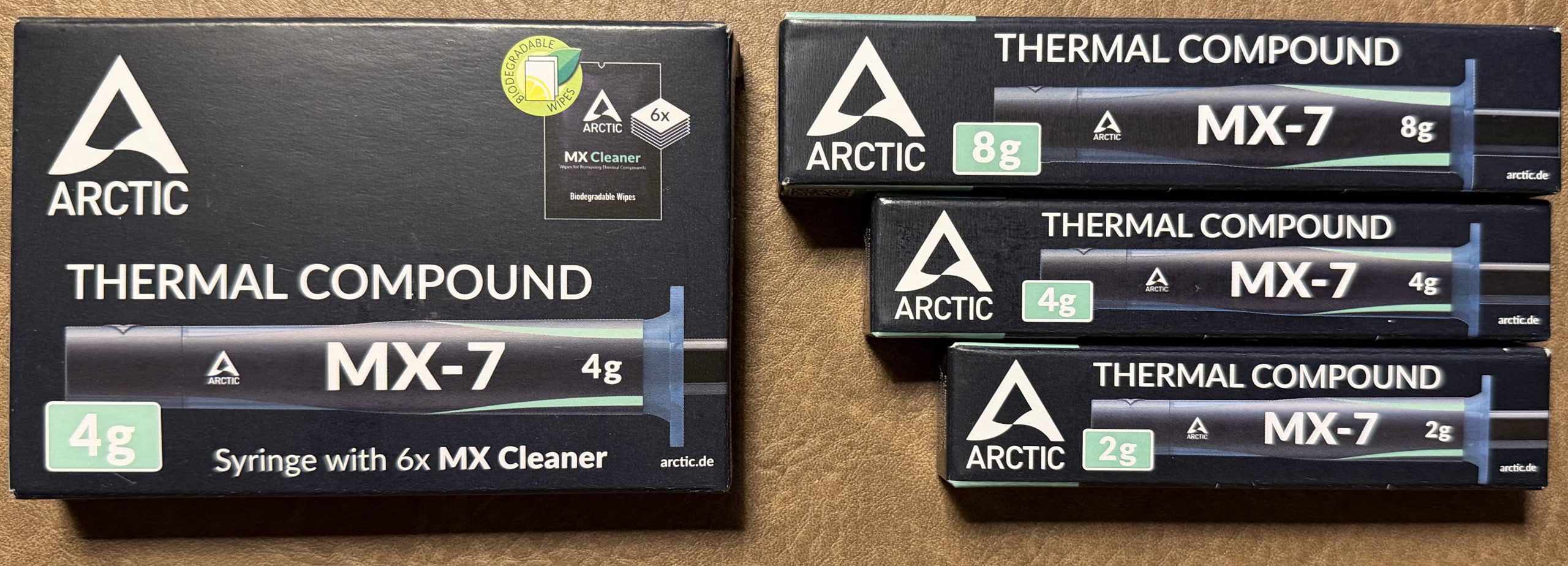
The packaging overview shows the complete MX-7 product line and makes it clear that ARCTIC takes into account the usual consumption profiles of users. The 2g, 4g and 8g variants cover the range from occasional users to enthusiasts who regularly mount coolers or run multiple systems. The smaller 2 g units offer a compact solution for one-off applications, while the 8 g version is particularly attractive for users who frequently rebuild or require a higher order volume. As usual, the 4 g version forms the middle ground and is likely to establish itself as the main variant, as it allows multiple applications in most scenarios.
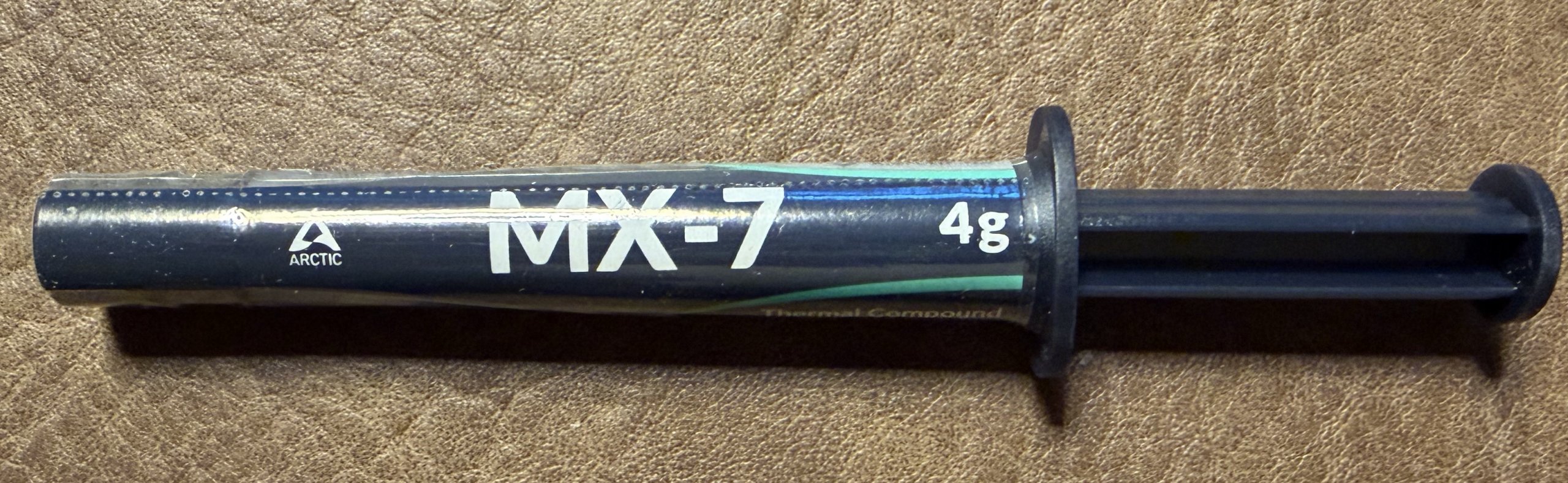
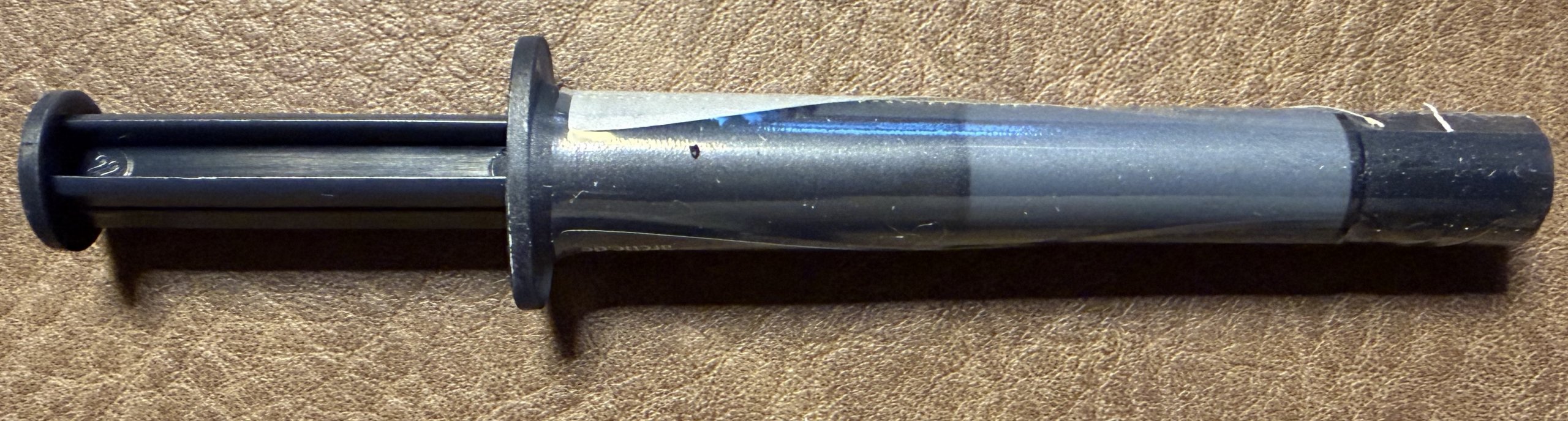
When unboxing the 4 g version with Cleaber, the packaging reveals very tidy contents. The syringe itself is wrapped separately in foil and is well protected by the plastic plunger. The design of the syringe corresponds to the current ARCTIC design, looks robust and offers sufficient space for the relevant information. The plastic plunger is stable so that the paste can be dispensed precisely. The printing is free of decorative elements and focuses on the clearly legible product name.
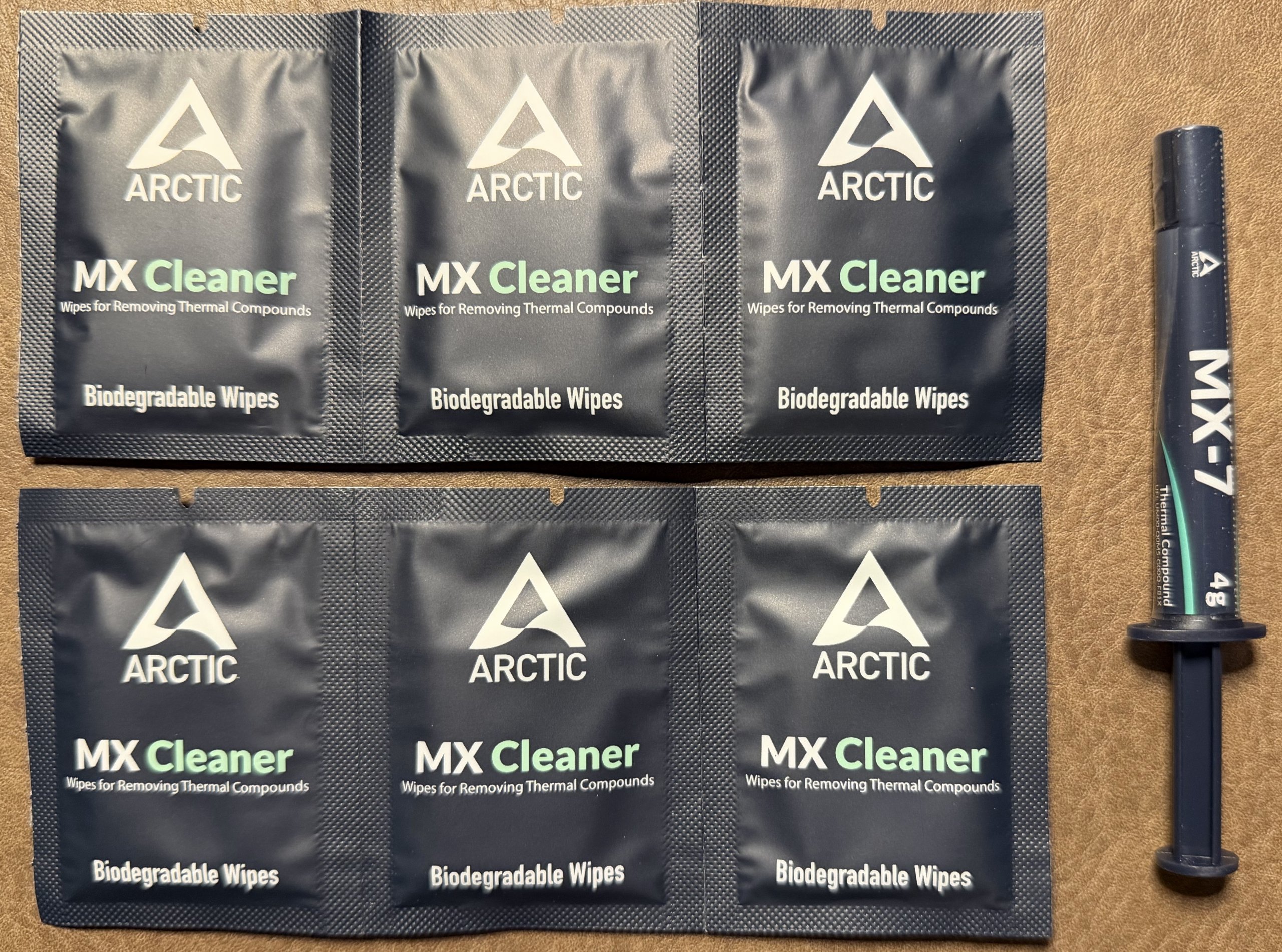
The MX Cleaner wipes are a central element of the accessories. The 4 g box contains six individually packaged cleaning cloths made of biodegradable material and based on ethanol and a small amount of essential oils. I find this addition practical as it reliably degreases both CPU and cooler and even removes old or dried paste residues well. The individual packaging keeps each wipe fresh and fully effective, which makes handling much easier and ensures clean preparation of surfaces. These wipes not only prevent contamination, but also help to keep the resulting bond line thickness as constant as possible, as residues and microfilms are reliably removed.
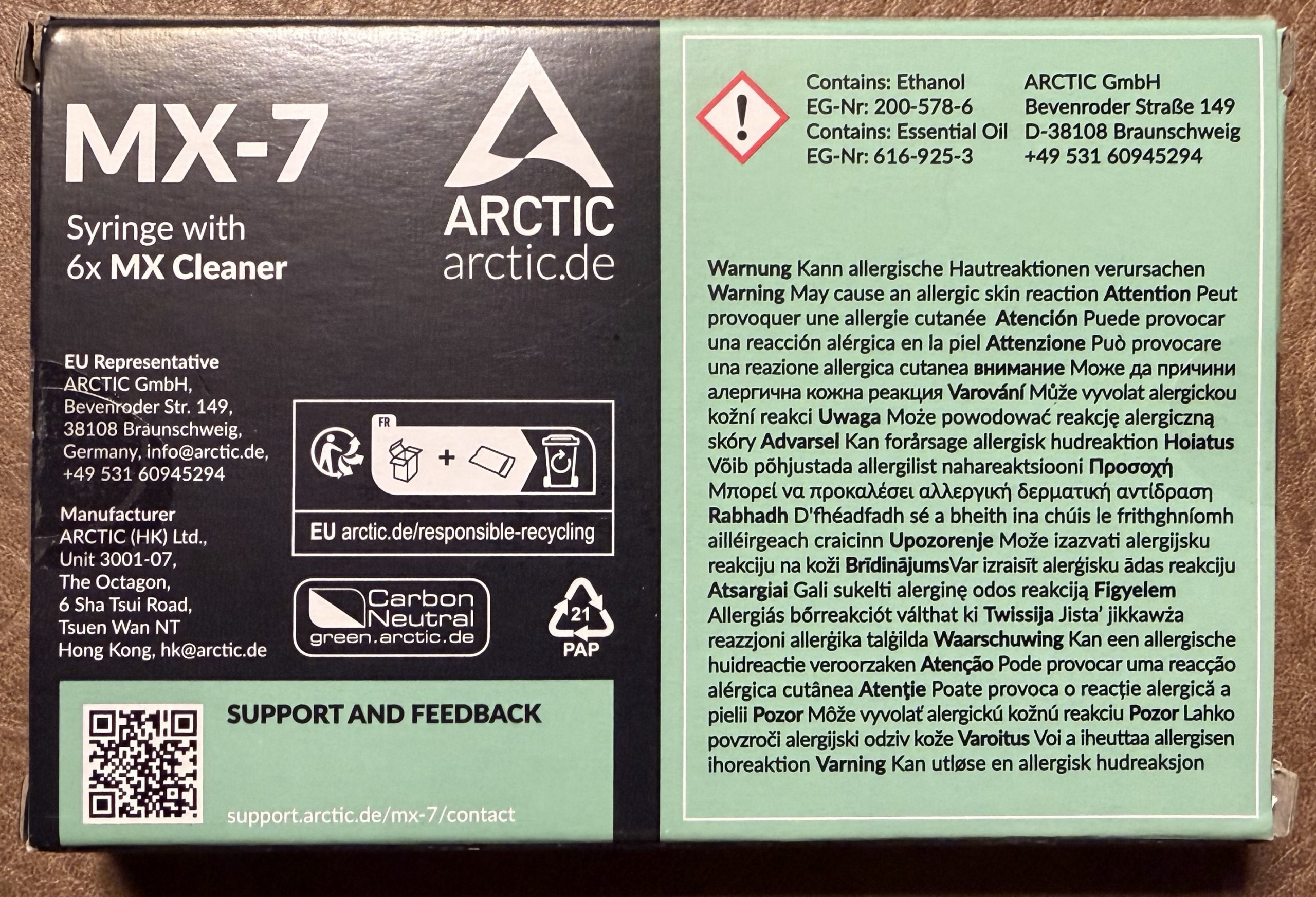
The smaller pack sizes also follow the same packaging approach, but do without the large box and do not usually contain an extended cleaning set. The 2 g and 4 g standard versions are supplied in smaller boxes containing only the syringe itself. The compact format reduces packaging material and is aimed at users who either already have their own cleaning utensils or only need the paste for occasional assemblies.
The unboxing of the MX-7 shows that ARCTIC has retained the character of the entire MX series. The presentation is matter-of-fact, the materials look high-quality and the manufacturer relies on comprehensible, practical solutions. The different pack sizes allow the user to choose according to their needs, while the accessories of the 4 g version offer additional functional added value, which is particularly noticeable for enthusiastic users and with repeated installations.
Below is a tabular summary of the advertised and realistically classifiable technical data:
| Property | Specification according to packaging |
|---|---|
| Model | MX-7 |
| Thermal conductivity (measurement) | 6.17 W/m-K Bulk |
| Interface resistance (measurement) | 2.8 mm²-K/W |
| Thermal resistance (measurement) | 0.03728 K/W at 12 µm |
| Color | Gray |
| Operating temperature | -50 °C to 250 °C |
| Viscosity | 35000 – 38000 Poise |
| Electrical conductivity | non-conductive |
| Density g/cm³ | 2,9 |
This shows that there is a considerable gap between the advertising promises and the physical reality. And that is precisely why we now need to measure the whole thing!
| Material analysis and microscopy | Basic knowledge | |
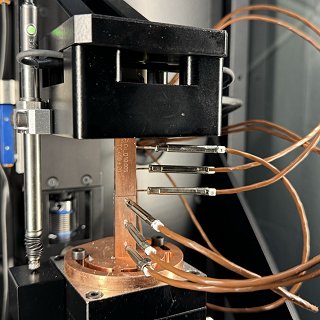 Here you can find out why effective thermal conductivity and bulk thermal conductivity can be completely different in practice, what role the contact resistance between the surfaces and the paste plays and how thermal paste can be measured accurately. There is also a detailed description of the equipment, the methodology and the error tolerances. Here you can find out why effective thermal conductivity and bulk thermal conductivity can be completely different in practice, what role the contact resistance between the surfaces and the paste plays and how thermal paste can be measured accurately. There is also a detailed description of the equipment, the methodology and the error tolerances. |
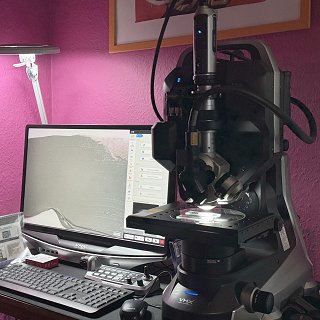 You will learn how laser-induced plasma spectroscopy works and the advantages and limitations of the measurements. There is also high-resolution digital microscopy and analysis of particle sizes. This information is also used to estimate the long-term stability of a paste. You will learn how laser-induced plasma spectroscopy works and the advantages and limitations of the measurements. There is also high-resolution digital microscopy and analysis of particle sizes. This information is also used to estimate the long-term stability of a paste. |
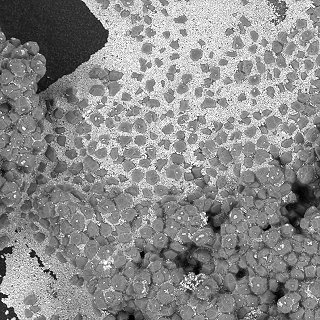 Anyone who has always wanted to know what is or is not in a paste and how these pastes are produced will find what they are looking for here. The basic article provides a better understanding of what is often sold for far too much money and sometimes with adventurous promises. Anyone who has always wanted to know what is or is not in a paste and how these pastes are produced will find what they are looking for here. The basic article provides a better understanding of what is often sold for far too much money and sometimes with adventurous promises. |


















64 Antworten
Kommentar
Lade neue Kommentare
Urgestein
1
Veteran
Veteran
1
Veteran
Mitglied
Veteran
Veteran
Veteran
1
Veteran
1
Veteran
1
Veteran
Urgestein
Mitglied
Mitglied
Alle Kommentare lesen unter igor´sLAB Community →