














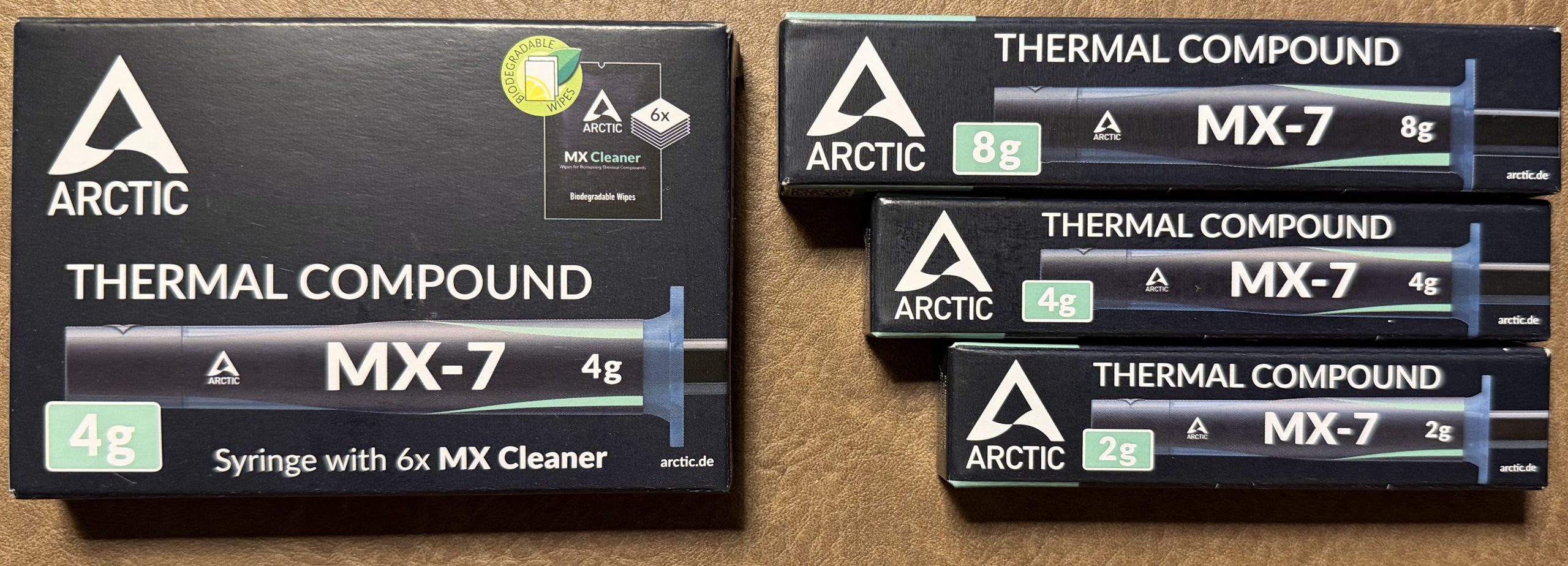
I’m taking today’s launch of the Arctic MX-7 at 2 p.m. (article in full depth only here, of course) as an opportunity to give you a brief, deliberately neutral impression, without anticipating the actual test, as this is not intended as an advertising text, but as a clean technical classification. What I can spoil about the release, however, is the frame: I consider the MX-7 not only as a classic thermal compound, but as a TIM in the overall sense, i.e. including layer thickness behavior, contact mechanics, possible aging and what really happens in the interface. This is exactly where it is ultimately decided whether a paste only sounds good in everyday use or remains stable over many cycles. Anyone expecting quick miracles from a pure thermal conductivity value on the box will, as so often, find that the real music is played elsewhere, namely in the effective thermal resistance of the boundary layer and in the question of how consistently a paste can maintain its minimum, practice-relevant bondline under real surface conditions. With this in mind, there will be a clear, technically guided test for the release, and I will also answer the typical comparison questions that you have been asking me regularly since MX-6, without turning them into artificial rankings based on snapshots.
Until then, however, it is worth taking a brief look at the TIM market, which is currently being shaped less by a single paste and more by a noticeable upheaval that is spilling over from the data center and power electronics into the end customer sector. While classic pastes remain important, the thermal discussion is increasingly being dominated by materials that would previously have been dismissed as an OEM issue: phase change foils, which only form cleanly during operation and can be more stable in the long term than some pastes, graphite and graphene-based pads, which hardly age but require more consistent handling, and hybrid solutions, in which liquid metal components no longer flow freely but are embedded in structures or elastic matrices in order to improve process safety and reliability. At the same time, the importance of gap fillers, putty and adhesive-type TIMs is growing because modern cooling solutions increasingly no longer address just one hotspot, but have to thermally connect entire assemblies with different heights, contact pressures and component types, from VRMs to memory and small controllers. So anyone who believes that in 2025 it will only be a question of whether paste A is one degree better than paste B is overlooking the fact that the real dynamic has long been moving towards system integration, and thus towards materials that are no longer just smeared on a heat spreader, but must be understood as a component in the thermal design.
This is precisely why there is an analysis parallel to the MX-7 test that will not only put your mind at rest, but in case of doubt will even provide more added value than a pure product comparison: I will take a look at what is really moving the market at the moment, which material classes are currently migrating from the industry to the consumer sector, which promises have substance, where the limits lie and why in the end it is not the highest laboratory value, but the interaction of application, layer thickness, contact surfaces, cycling and ageing that is decisive. So if you are curious about the MX-7, you will get the classification just in time for the release, and if you want to know in the meantime why “TIM” is now much more than “paste”, you will get exactly this broader perspective as context, so that the later measurement results do not appear isolated, but can be clearly located in the current trend picture.
Thermal Interface Materials (TIM) form the essential layer between hot components (processor, power chip, LED, etc.) and heat sinks. This year, too, there have been numerous innovations in this area in order to keep pace with increasing power densities and new applications. In IT and power electronics in particular (servers, CPUs/GPUs, power supplies, power modules in electric vehicles, LED lighting technology, high-frequency components, etc.), new types of TIMs are being developed, tested and some are already being used commercially. The most important material categories, i.e. liquid metals, graphene-based TIMs, phase change materials and other innovative thermal conductive pastes/composites, as well as their fields of application and current developments are presented in a structured manner below.
Liquid metal-based TIMs
Liquid metal TIMs, mostly based on gallium (e.g. Galinstan from Ga-In-Sn), offer extremely high thermal conductivities in the range of 40-70 W/m-K and excellent wetting of metallic surfaces. They have been used for several years in the enthusiast and console sector (e.g. in the PlayStation 5) to reduce CPU/GPU temperatures. New from 2025 is the increased focus on the use in servers and AI hardware as well as improving the reliability of such TIMs. One highlight is Boston Materials’ Liquid Metal ZRT®, a TIM made of liquid metal in a matrix reinforced with carbon fibers. The first product (LMZ1100) brought over 10 °C lower chip temperatures in kilowatt-sized, liquid-cooled AI accelerators and GPUs. This composite structure also increases long-term reliability and can be integrated into standard production processes. Based on this success, a second generation will be developed together with Mitsubishi Chemical in 2025 to further increase performance.
Hybrid approaches are also proving successful: Intel has presented a combination of liquid metal and elastic silicone TIM. Liquid metal is used in the center of the chip for maximum heat transfer, while a silicone-based TIM absorbs mechanical stresses at the edge. A special sealing frame (“dam”) holds the metal in position. This design significantly reduces the thermal resistance between the chip and the heatspreader without jeopardizing reliability. This addresses classic problems of liquid metals such as “pump-out” (squeezing out during temperature cycles) and leakage.
Liquid metal TIMs are thus finding their way into high-performance servers and advanced packaging. Meanwhile, TSMC (as of 2025) still relies on more conventional polymer TIMs in its 2.5D/3D chip housings, but Intel’s success shows that new thermal limits can be pushed with material hybrids. Commercial liquid metal products are also being developed in the industry: Indium Corporation, for example, offers liquid InGa and InGaSn alloys as TIM0/TIM1 for chip assembly, which achieve very low interfacial resistances thanks to excellent wetting against many surfaces. For serial applications, low-melting metal TIMs are sometimes used, which only become liquid above room temperature; more on this in the section on phase change materials.
Liquid metal composite TIMs (such as LM ZRT) are already being used in data centers and AI accelerators to cope with the waste heat from extremely powerful ASICs and GPUs. In the consumer sector, some high-end laptops and consoles use gallium-containing TIMs, albeit with caution (insulating seals, limited transport layers) due to conductivity and possible material incompatibility (gallium attacks aluminum, for example). Free liquid metals are rarely used directly in automotive power electronics due to vibration and electrical requirements; here, embedded solutions are used (see “Other innovative materials”). Nevertheless, the developments mentioned above show that liquid metals will be recognized as the key to higher cooling performance from 2025, with new approaches to circumvent their disadvantages.
Graphene-based TIMs
Graphene and related carbon materials are currently revolutionizing thermal management. Graphene has an in-plane thermal conductivity of up to ~5000 W/m-K, orders of magnitude higher than copper. Graphene-based TIMs are therefore being intensively researched and some are already on the market. There are different types:
- Graphene-filled thermal conductive pastes: Here, graphene nanoflakes are added to a carrier material (silicone oil or polymer). Manufacturers such as GrapheneTech (Spain) offer pastes that achieve three times higher conductivity than standard thermal conductive pastes. Such pastes reduce CPU/GPU temperatures and are electrically non-conductive when oxidized graphene is used. A homogeneous dispersion of the graphene flakes is important to avoid aggregation.
- Graphite/graphene foils (thermal pads): Thin flexible films made of graphite or graphene layers serve as a reusable TIM alternative. One example is Thermal Grizzly KryoSheet, a graphene-based pad developed as a high-end replacement for thermal pastes. It offers very high thermal conductivity and does not age as it does not contain any liquid components. Smartphones (e.g. Realme GT 7) use such graphene sheets for efficient heat dissipation in compact housings, and they are also being tested for PC GPUs. KryoSheet uses a special production process in which the graphite crystallites are broken up along the layer plane and stacked in the Z direction in order to make optimum use of the anisotropic conductivity. However, such foils are electrically conductive and therefore require careful application. Overall, graphite pads enable consistently high performance over many years without drying out or pump-out.
- Graphene-based adhesives and composites: Durable TIM solutions are in demand for power modules and automotive. Here, graphene-nano-reinforced adhesives are being developed that serve as both a structural bond and a thermal interface. For example, Henkel is working with the Swedish start-up Smart High Tech (SHT) to bring graphene-reinforced TIM to market under the Loctite brand. These are intended to meet the growing cooling requirements in AI data centers, telecom infrastructure, aerospace and autonomous driving systems. Graphene significantly improves the thermal conductivity of polymer matrices, especially when combined with classic fillers such as boron nitride. Panasonic already uses graphite foils (GraphiteTIM) in IGBT and GaN power modules to dissipate heat from the semiconductors to the heat sink. In turn, graphene pads are used in LED lights to keep the LED chips cool in a confined space.
- Emerging trends: The industry is researching printable TIM coatings with graphene in order to apply thin, highly conductive layers directly to heat spreaders, for example. Hybrid films made of graphene and carbon nanotubes (CNTs) are also being investigated in order to control anisotropic heat conduction in a targeted manner. Another idea is to combine graphene with phase change materials to achieve a kind of “intelligent” heat conduction; graphene would conduct the heat flow while the PCM absorbs excess energy in the event of overheating.
Graphene-based TIMs made the step from research to practice in 2025. In consumer electronics (smartphones, laptops), they already ensure temperatures are a few degrees lower. In electric vehicles, graphene TIMs keep batteries and power electronics cooler more efficiently. And in high-frequency and 5G systems, graphene solutions are expected to provide flat, lightweight cooling without metallic heat spreaders (which reduces weight). The challenge remains to provide graphene cheaply in large quantities and distribute it evenly in matrices. Nevertheless, graphene is seen as one of the breakthrough materials for the next generation of TIM in 2025.
Phase change materials (PCMs) as TIMs
Phase change TIMs are materials that become softer or liquid at higher temperatures and thus optimally wet the contact surfaces, but become solid(er) again when they cool down. This class has existed for some time (e.g. wax-based pads for CPUs), but will undergo important innovations from 2025 in order to keep pace with the increasing requirements.
- Polymer-based phase-change pads: Traditional PCM pads consist of a mixture of polymer matrix (e.g. kerosene, resin) and fillers. When cold, they are solid and easy to handle; above the phase transition (typically 45-60 °C), they soften considerably and fill micro-uneven areas almost like a fluid. This significantly reduces the thermal contact resistance without the material leaking completely. One example is Honeywell PTM7950, which has long been known in the enthusiast community for its outstanding results. The Honeywell PTM6880, optimized for the high demands of AI server chips, was recently introduced. This PCM matrix uses a new polymer that virtually eliminates pump-out effects and resists warping up to 120 µm, with development potential up to 300 µm. This addresses the large, easily bending chip modules of AI accelerators in particular. In 2025, Henkel also developed a silicone-free phase change TIM that enables very thin layer thicknesses with minimal contact pressure, ideal for compact server CPUs/packages with up to 800 W power dissipation. For end users, Thermal Grizzly Phase Sheet PTM has had an easily accessible PCM pad in its program since 2025, which is available for approx. 9 € per pad. Tests showed a thermal conductivity of >6.5 W/m-K in the molten state and a very low thermal resistance of 0.048 K/W at ~22 µm layer thickness. The material begins to melt at approx. 40 °C and is fully “liquid” at ~55 °C. After about ten hot-cold cycles, the performance stabilizes permanently. Such PCM pads offer the advantage over pastes that there is no drying out and they are designed for many thermal cycles, ideal for high-performance GPUs with large temperature changes, for example.
- Metallic phase-change TIMs: Low-melting-point metal alloys are a special sub-category of TIMs. They are solid at room temperature, but melt just above this temperature (typically 30-60 °C). Indium Corporation has developed such phase-change metal alloy (PCMA) TIMs, some of which melt at ~30 °C. In operation, they therefore behave similarly to liquid metal (very high thermal conductivity, excellent wetting), but remain solid when switched off, which facilitates volume control and automated processing. Both gallium-based variants and Ga-free alloys are available. The thermal performance gain is similar to that of pure liquid metal, but with better manageability in mass production. Such PCMAs are particularly envisaged for TIM1.5 applications, e.g. between a chip package (or intermediate plate) and the heat sink, where thin layers and high conductivity are required.
Phase change TIMs can be found in practically all areas of electronics cooling. In server CPU/GPU modules, polymer PCM pads are valued because they can simply be applied as a film during the assembly process and then independently ensure optimum contact during operation; some high-performance CPU cooling solutions specify PCM pads instead of paste in order to extend maintenance intervals. In power modules in the automotive industry, pre-coated phase change films have been standard for years, such as IGBT modules, which “melt” their heat conducting film during initial commissioning and thus ensure stable thermal contacts in the long term. The new PCM formulations (e.g. Henkel, Honeywell) are particularly relevant for the upcoming SiC-based high-performance units, as they remain dimensionally stable despite greater heat and stress and do not exhibit any “pump-out” problems. In LED light sources (e.g. for spotlights or projectors), phase change pads are used to reliably cool the LED chips in a compact design without liquid materials escaping from the joint when not in use. Ultimately, PCM TIMs offer a compromise between pastes and solid pads: they combine the surface adaptability of a liquid with the handling safety of a solid, a property that will be even more in demand in 2025.
Other innovative thermal conductive materials and trends
In addition to the major categories, hybrid and nano-materials will also be on the rise in 2025 to meet special requirements:
- Liquid Metal Embedded Elastomers (LMEE): to make liquid metal usable for harsh applications (e.g. automotive), elastic matrices with embedded metal microdroplets are being developed. Arieca (USA) is a pioneer with the ALT-TIM series. Here, droplets containing gallium are enclosed in a stretchable, sticky silicone. These TIMs achieve very low thermal resistances similar to liquid metal, but are highly reliable and easy to process (automatic dispensing and pressing). Because the metal droplets are encased in the elastomer, they can withstand deformation and thermal shocks without cracking or oxidizing. in 2025, Arieca and ROHM Semiconductor demonstrated that a SiC power module (300 kW inverter) can be bonded to the heat sink using LMEE instead of conventional soldered or silver-sintered TIM. The result is simplified assembly without expensive process steps and high reliability in the temperature cycling test. This reference was presented at PCIM 2025, an indication that LMEE TIMs are close to market maturity in e-vehicles. LMEEs are also interesting for high-performance CPU/GPU modules as they offer liquid metal-like cooling performance without the risks of free liquids.
- Vertically aligned carbon nanotubes (CNT) TIMs: Carbon nanotubes have been researched for years as a thermal material and have also found their way into practical products in 2025. Carbice (USA), for example, manufactures a TIM in the form of a thin foil pad with millions of vertical CNTs grown on a metal foil and fixed at one end. The free ends of the tubes form an elastic, thermally conductive surface. Such a Carbice® pad maintains thermal performance even under extreme continuous load and shows hardly any signs of ageing, unlike traditional pastes or filled pads, which dry out or deform over time. The key to success was to anchor the CNTs firmly and coat them specially so that they remain both mechanically flexible and make good contact with the tips. Carbice markets different variants: for satellites and space travel (Space Pad®, already in use in satellites), for industrial/power electronics and, more recently, as Ice Pad® for gaming PCs. For the first time, PC enthusiasts can now also use a paste-free, CNT-based pad which, according to the manufacturer, will still perform just as well after 10 years as it did on the first day. Major players are taking notice: Dow (Dow Corning) entered into a strategic partnership with Carbice in 2024 to combine silicone-based TIM gels with CNT technology. The aim is to jointly develop customized solutions for e-mobility, industry and consumer appliances. The idea behind it: The excellent gap filling and wetting of liquid silicone is combined with the robustness and high conductivity of CNT pads to enable the thinnest transitions with minimal stress. Such hybrid products could be used in battery packs or radar sensors, for example, where conventional pads would be either too stiff or not conductive enough.
- Highly thermally conductive pastes and adhesives: Conventional thermally conductive pastes will also be further developed in 2025. The focus will be on long-term stability (no drying out, less silicone bleed) and higher thermal conductivity values thanks to new fillers. Some manufacturers rely on metal or diamond nanoparticles in non-silicone-based carrier oils to achieve conductivities >10 W/m-K with minimal ageing. For power electronics in HF technology, electrically insulating TIMs are particularly important (to avoid interference effects). Ceramic-filled epoxy adhesives or gap filler gels are used here, reinforced with hexagonal boron nitride (h-BN), for example. Boron nitride is known as “white graphite” and has high thermal conductivity combined with very good electrical insulation. in 2025, progress is being made in aligning boron nitride platelets in the matrix in an ordered manner (e.g. using an electric field), which significantly increases the resulting thermal conductivity. The first commercial printable h-BN LM hybrid inks have also been demonstrated, which can be applied as a TIM layer by screen printing, for example. Such technologies could be used in the 5G infrastructure (antenna amplifiers, transceivers), where thin, insulating and highly effective TIM layers are required.
It can therefore be stated that TIM innovations from 2025 onwards will be strongly driven by the requirements of AI data centers, electromobility and new power semiconductors. Liquid metals, 2D materials such as graphene, adaptive phase change materials and nanocomposites will mark the transition from traditional “thermal pastes” to highly developed thermal interface solutions, some of which will be launched on the market as independent products or driven forward in strategic partnerships (Henkel, Dow with start-ups). This development is likely to gain further momentum in the coming years, as thermal management plays a key role in reliability and increased performance in almost all high-tech industries.



















11 Antworten
Kommentar
Lade neue Kommentare
Urgestein
1
1
Mitglied
Urgestein
Urgestein
1
Urgestein
Mitglied
Urgestein
Mitglied
Alle Kommentare lesen unter igor´sLAB Community →